Posted by sydney on Feb 13th, 2008
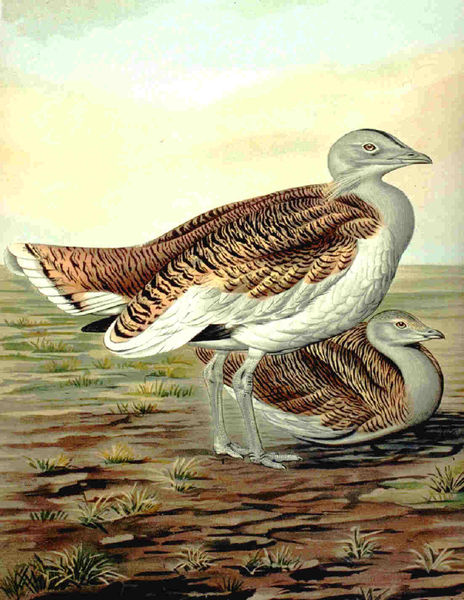
Great Bustard
- 1792: February 13, 1792 – Sowed the ashes of my own making in the great mead, where the grass is finest. Finished tacking the fruit wall-trees. Gossamer streams from the boughs of trees. Brimstone butterfly, Papilio rhamni.
- 1791: February 13, 1791 – As there has been little frost, the antirrhinum cymb: flourishes, & blossoms thro’ the winter.
- 1789: February 13, 1789 – Lined the hot-bed screen with reeds. Cucumbers come-up well: bed works well.
- 1784: February 13, 1784 – This evening the frost has lasted 28 days.
- 1782: February 13, 1782 – Things froze in the pantry. Shallow snow: ground very hard.
- 1781: February 13, 1781 – Stormy all night. Much thatch blown-off, & some trees thrown down.
- 1780: February 13, 1780 – Turnips are all rotten.
- 1774: February 13, 1774 – Hedge-sparrow sings. Great flock of buntings in the fields towards Faringdon.
- 1772: February 13, 1772 – Wood-pecker laughs. Spring-like weather. Skylark mounts & sings. Crocus begins to blow.
- 1770: February 13, 1770 – Saw bustards on Salisbury plain: they resemble fallow-deer at a distance. Partridges pair. Wild-geese in the winter do damage to the green wheat on Salisbury plain.
The Great Bustard became extinct in Britain in the 1840s; hardly surprising given the inevitable fate of unusual and notable birds mentioned in these journals (shot, shot, shot, and shot. Changing farming practices also bear some responsibilty). They are currently being reintroduced with some success by the Great Bustard Group.
Posted by sydney on Feb 12th, 2008
- 1793: February 12, 1793 – Mrs. J. White returns.
- 1789: February 12, 1789 – About this time Miss Chase, & Miss Rebecca Chase sailed for Madras in the Nottingham India-man.
- 1781: February 12, 1781 – Sea-gulls appear: in stormy weather they leave the sea.
- 1780: February 12, 1780 – The farmers begin to plow after the frost.
- 1777: February 12, 1777 – About the beginning of July, a species of Fly (Musca) obtains, which proves very tormenting to horses, trying still to enter their nostrils, and ears, & actually laying their eggs in the latter & perhaps in both of those organs. When these abound, horses in wood-land districts become very impatient with their work, continually tossing their heads & rubbing their noses on each other, regardless of the driver: so that accidents often ensue. In the heat of the day, men are often obliged to deist from plowing: saddle-horses are also very troublesome in such season. Country-people call this insect the nose fly. In the decline of the year when the morning & evening become chilly, many species of flies (muscae) retire into houses, & swarm in the windows. At first they are very brisk & alert: but as they grow more torpid, one cannot help observing that that they move with difficulty, & are scarce able to lift their legs, which seem as if glued to the glass: and by degrees many do actually stick on till they die in the place. Now as flies have flat skinny palms, or soles to their feet, which enable them to walk on glass & other smooth bodies by means of the pressure of the atmosphere; may not this pressure the the means of their embarrassment as they grow more feeble; ’til at last their powers become quite inadequate to the weight of the incumbent air bearing hard upon their more languid feet; & so at last they stick to the walls & windows, where they remain, & are found dead.
- 1775: February 12, 1775 – Sad accounts from various parts of devastations by storms & inundations. A spoon-bill platalea leucorodia Linn: was shot near Yarmouth in Norfolk: it is pretty common in Holland, but very rare indeed in this island. There were several in a flock. They build Willughby says, like Herons in tall trees. Their feet are semipalmated. Those birds in Norfolk must have crossed the German ocean.
- 1770: February 12, 1770 – Yellow-hammer, emberiza flava, sings. Bee gathers on the snow-drops. Bunting sings.
- 1769: February 12, 1769 – Snow, fog, sleet. Icicles. Snow on the hills.
White will speculate again 14 years later on the flies-on-windows issue, but his vacuum theory is incorrect– insects use fine velcro-like hairs to stick to smooth surfaces.
Posted by sydney on Feb 11th, 2008
- 1793: February 11, 1793 – Paths get dry. Sowed a bed of radishes, & carrots under the fruit-wall.
- 1792: February 11, 1792 – The meadow measures 2 acres & 19 rods, besides the dug ground.
- 1790: February 11, 1790 – Three gallons of best french brandy from London.
- 1784: February 11, 1784 – Snow covers the ground. Hares again in the garden.
- 1780: February 11, 1780 – Eruptive fevers, & sore throats lurk about the parish: some die of this disorder.
- 1773: February 11, 1773 – Reduced my barometer to the true standard of 28 inches, lowering it about two degrees.
- 1772: February 11, 1772 – Large titmouse sings.. Chaffinch sings. Hot sunshine. Snowdrops blow.
- 1770: February 11, 1770 – Linnets whistle inwardly as they sit in flocks.
- 1768: February 11, 1768 – Went to Oxford from London.
Posted by sydney on Feb 10th, 2008
- 1791: February 10 – Brewed strong beer.
- 1790: February 10, 1790 – Bullfinches pick the buds of damson-trees.
- 1787: February 10, 1787 – Took Mrs. Etty’s ashes, 28 bushels; paid her.
- 1784: February 10, 1784 – No hares have frequented the garden since the man shot, & killed one, & wounded an other.
- 1783: February 10, 1783 – Sheep rot very much. Ewes & lambs are much distressed by the continual wet.
- 1781: February 10, 1781 – The nuthatch brings his nuts almost every day to the alcove, & fixing them in one corner of the pediment drills holes in their sides, & after he has picked out the kernels, throws the shells to the ground.
- 1775: February 10, 1775 – Mezereon in fine bloom. Peter Wells’s well runs over. Spiders, woodlice, lepismae in cupboards, & among sugar, some empedes, gnats, flies of several species, some phalenae in hedges, earth-worms, &c., are stirring at all times when winters are mild; & are of great service to those soft-billed birds that never leave us.
- 1774: February 10, 1774 – Weather shifts continually from frost to rain to the detriment of the wheat & turneps. Wheat looks sadly, & is almost heaved-out of the ground.
- 1773: February 10, 1773 – Severe frost. Bottles of water freeze in chambers. Snow in the night. Cutting air.
- 1772: February 10, 1772 – Made cucumber bed. Snow gone on the hills. Winter aconite blows.
Posted by sydney on Dec 31st, 2007
- 1790: December 31, 1790 – Total of rain in 1790, 32 inch. 27 h.
- 1789: December 31, 1789 – Storm in the night, that blew down my rain-measurer. The newspapers say that there are floods on the Thames.
- 1785: December 31, 1785 – Snow covers the ground.
- 1784: December 31, 1784 – Much snow on the ground. My laurel-hedge, & laurustines, quite discoloured, & burnt as it were with the frost.
- 1783: December 31, 1783 – Ice under people’s beds. Water bottles burst in chambers. Meat frozen. The fierce weather drove the snipes out of the moors of the forest up the streams towards the spring-heads. Many were shot round the village.
- 1782: December 31, 1782 – Baromr in 1782 at S. Lambeth.
lowest April 1………… 28:5-10;
highest Nov 13 ………….. 30: 13-20 or 6 1/2;
Therm: lowest Feb 12 ……………. 23;
highest June 18 ……………….. 81
- 1776: December 31, 1776 – A grosbeak was shot near the village. They sometimes come to us in the winter.
- 1775: December 31, 1775 – The country-people, who are abroad in winter-mornings long before sun-rise, talk of much hard frost in some spots, & none in others. The reason of these partial frosts is obvious: for there are, at such times, partial fogs about: where the fog obtains little or no frost appears; but where the air is clear there it freezes hard. So the frost takes place either on the hill or in dale, where every the air happens to be clearest, & freest from vapour. Hyrn, cornu vel angulus: whence our Faringdon Hyrn, or hern as we pronounce it, is the corner-field of our parish. Heane, Humilis: hence perhaps our honey-lane. Our Gally-hill, is perhaps gallows hill from Galga, crux. Does not domesday book among other privileges, say that Priors & c. were allowed Furcas, gallows? By, habitation: from whence ye adjective Byn, as Binsted, &c. Deortun, saltus: hence no doubt our Dorton, a wild, bushy common just below the village: Deerton, a place where deer are kept. Eowod, Ovile: hence perhaps our field called the Ewel? Ymbhanger the winding hanger: we have places so named. Rode, crux: hence our Rode-green near the Priory, where probably a cross was erected. Fyrd, a ford; also a camp: hence probably our high common-field to the N.W. is called the fordown. Ether, sepes: the top border that binds down our hedges & keeps them together is called by our hedgers ether to this day: the wickering the top along they call ethering. Gouleins (Gothic) salutatio: hence perhaps our word Golly, a sort of jolly kind of oath, or asservation much in use among our carters, & lowest people. Eorthwicga, blatta terrana: hence our absurd word, not peculiar to this district: earwig.
- 1773: December 31, 1773 – Frost all day.
- 1768: December 31, 1768 – A wet season began about the 9th of June, which lasted thro’ haymaking, harvest, & seed-time, & did infinite mischief to the country. It appears from my Brother Barker’s instrument, with which he measures the quantity of rain, that more water fell in the county of Rutland in the year 1768 from Jan. the 1 to Dec 31 than in any other Calendar year for 30 years past; viz. 30 1/2 inches. A mean year’s rain in Rutland is about 20 3/4 inches.
Notes:
Brother Barker was White’s brother-in-law, married to his sister Anne. The lengthy entry on possible Saxon roots for local place-names is one of the few indications in the journals that White was almost as keenly interested in local history– what would have been called “Antiquarianism”– as he was in natural history. The full title of The Natural History of Selborne is in fact The Natural History and Antiquities of Selborne, although the letters concerning the antiquities are often omitted from modern editions of the book, lacking as they are in the vividness of direct observation that makes White’s writing so timeless; although they do have a hobbity charm of their own.Here is a nice article on the first grammar of Anglo-Saxon, with observations on the antiquarian spirit.
Posted by sydney on Dec 30th, 2007
Notes:
Papilio Io is the Peacock butterfly, which hibernates sometimes in houses. Otherwise a slow day in Selborne.
Posted by sydney on Dec 29th, 2007
- 1792: December 29, 1792 – Mr. B. & wife left us.
- 1790: December 29, 1790 – On this day Mrs Clements was delivered of a boy, who makes my nephews & nieces again 57 in number. By the death of Mrs Brown & one twin they were reduced to 56.
- 1788: December 29, 1788 – Many wild geese in the moors of the forest.
- 1783: December 29, 1783 – Carryed some savoy-heads, endive, & celeri into the cellar: the potatoes have been there some days. Red breasts die. Ground covered with ice & snow.
- 1780: December 29, 1780 – Snow totally gone.
- 1770: December 29, 1770 – Wrens whistle all the winter except in severe frost. Wrens whistle much more than any English bird in a wild state. The redbreast sings great part of the year; but at intervals is silent. This year concludes with a very wet season, which has lasted from the middle of Octr last, & has occasioned vast floods, & desolation both at home & abroad. Much wheat-land in wet countries remains unsown.
Posted by sydney on Dec 1st, 2007
- 1792: December 1, 1792 – Thomas started a hare, which lay in her form under a cabbage, in the midst of my garden. It has begun to eat the tops of my pinks in many places. The land-springs, which begin to appear, are much abated.
- 1791: December 1, 1791 – Mr & Mrs Ed. White left us. The Hermitage, new capped with a coat of thatch, & embellished with a large cross, makes a very picturesq object on the hanger, & takes the eye agreeably.
- 1788: December 1, 1788 – Several wells in the village are dry, & some ponds in the neighbourhood. Well-head runs much as usual. There is a fine perennial spring at the bottom of Hasteds. Men cart earth, & marl from Clay’s pond.
- 1786: December 1, 1786 – The downs are very heavy.
- 1783: December 1, 1783 – Some ivy-berries are near full grown: others, & often on the same twig, just out of bloom. Farmer Lassam has more than 20 young lambs: some fallen some days, near a fortnight.
- 1782: December 1, 1782 – One of the keepers of Wolmer-forest sent me a peregrine falcon which he shot this day on the verge of the forest, as it was devouring wood-pigeon it had just taken. The Falco Peregrinus, or Haggard Falcon, mentioned in the last page but one, is a noble species of Hawk, seldom seen in the southern counties. In winter 1766 one was killed in the neighbouring parish of Faringdon, & sent by me to Mr Pennant in N. Wales. Since that time I have met with none till now. The specimen before me is in fine preservation, not being at all injured in the shooting. It measures 42 inches & upwards from wing to wing, & 21 from bill to tail, & weighs 2 pounds & an half standing weight. This species is very robust, & wonderfully formed for rapine: it’s breast is plump, & muscular: its thighs long, & thick, & brawny; it’s legs remarkably short, & well-set: the feet are armed with most formidable sharp talons. The eye-lids, & Cere of the bill are yellow, but the Irides of the eyes are dusky the bill is thick, & hooked, & of a dark colour, & has a jagged process near the end of the upper mandible on each side. It’s tail is short in proportion to it’s bulk but the wings tho’ long, when closed, fall short of the train. From it’s large & fair proportions it may be supposed to be a female. Probably it was driven from the mountains of N. Wales, or Scotland, where it is known to breed, by the late deep snows, & rigorous weather. The plumage answers well to Brit. zoology 4: vol: 1: p: 156. For a bird of prey, this was in high case; it’s intestines very fat. In it’s craw were many barley-corns, which probably came from the crop of the wood-pigeon on which it was feeding when shot. Voracious birds, when devouring their quarry, swallow feathers, & bones, & all parts indiscriminately.
- 1779: December 1, 1778 – Planted an old Newington-peach, & a Roman nectarine.
- 1777: December 1, 1777 – The brick-layers began to lay on the second coat of plaster in my new parlor.
- 1775: December 1, 1775 – Many species of flies come forth. Bats are out, & preying on phalaenae. The berries of Ivy, which blowed in the end of Sep: now half grown. A noble & providential supply for birds in winter & spring! for the first severe frost freezes, & spoils all the haws, sometimes by the middle of Novr. Ivy-berries do not seem to freeze. Large, grey, shell-less cellar snails lay themselves up about the same time with those that live abroad: hence it is plain that a defect of warmth alone is not the only causes that influences their retreat. The rudiments of the arbutus-fruit swell, & grow. Laurustines continue to blow.
- 1773: December 1, 1773 – Birds on the downs are rooks, larks, stone-chats, kites, gulls: some field-fares, some hawks.
- 1771: December 1, 1771 – Hot sun. Cloudless & still. Dark clouds to the S.W. Bats about.
- 1770: December 1, 1770 – Some oaks have yet some green leaves. Those oaks that were eaten bare by the chafers leafed about midsumr & continued unusally green late into Novemr.
- 1768: December 1, 1768 – Vast floods. Vast rain & stormy wind all night.
Posted by sydney on Oct 15th, 2007
- 1791: October 15, 1791 – Bro. Ben, & wife Hannah came. Woodcock, & red wings return, & are seen.
- 1790: October 15, 1790 – Gathered in the royal russets, & the nonpareils, a few of each. Gathered the berberries.
- 1789: October 15, 1789 – Mackerel sky. A wheat-ear seen on the down.
- 1788: October 15, 1788 – Vast quntities of gossamer: the fields are covered with it: “slow thro’ the air/The gossamer-floats; or stretch’d from blade to blade/ The wavy net-work whitens all the fields.”
- 1786: October 15, 1786 – Prodigious damage appears to be done by the late tempests, all over the kingdom; & in many places abroad.
- 1785: October 15, 1785 – Hay lies about in Berkshire & Oxforshire.
- 1783: October 15, 1783 – Nep. Harry Woods left me, & went to Funtington.
- 1780: October 15, 1780 – The cause, occasion, call it what you will, of fairy-rings, subsists in the turf, & is conveyable with it: for the turf of my garden-walks, brought from the down above, abounds with those appearances, which vary their shape, & shift situation now in segments, & sometimes in irregular patches, the seeds of which were doubtless also brought in the turf. Hunter’s moon. Much lightening, & thunder. This storm did much damage at Hammersmith, Putney, Wandsworth, &c. in the Isle of Wight, & at Plymouth, &c. &c. This stomr did great damage in the isl of Wight, Lancashire, & at Torbay where our fleet of observation lay, & over on the coast of France near Brest: & was part of the hurricane which occasioned such horrible devastations in the W. Indies.
- 1776: October 15, 1776 – My largest wall-nut tree produced four bushels & a half of nuts many bunches contained 8, 9, & on to 15 wallnuts each.
- 1775: October 15, 1775 – Mr Barker writes word that in Sep. last there fell in the county of Rutland near six inch. & 1/2 of rain. The beeches on the hanger, & the maples in my fields are now beautifully tinged, & afford a lovely picturesque scape, very engaging to the imagination.
- 1769: October 15, 1769 – Hedge sparrow whistles. Sprinkling rain. Three martins appear, & settle under the eaves of the stable.
Posted by sydney on Oct 14th, 2007
- 1790: October 14, 1790 – Gathered in more dearlings: the fruit is small, but the crop on that single tree amounts to nine bushels, & upwards.
- 1788: October 14, 1788 – Women & children go a-acorning, & sell their acorns at one shilling pr bushel.
- 1786: October 14, 1786 – Men sow wheat in good order at Temple & Wick-hill. The hop-planters of this parish returned from Wey-hill fair with chearful faces, & full purses; having sold a large crop of hops for a good rice. The hops of Kent were blown away by the storms, after the crop of this country was gathered in.
- 1785: October 14, 1785 – Grey & mild.
- 1784: October 14, 1784 – Finished gathering-in the apples. Apples are in such plenty, that they are sold for 8d per bushel.
- 1783: October 14, 1783 – The potatoes in the meadow small, & the ground very stiff. Low creeping frogs.
- 1782: October 14, 1782 – Sister Barker & her two daughters left Selborne.
- 1781: October 14, 1781 – The greens of turnips wither, & look rusty. The distress in these parts for want of water is very uncommon. The well at the Grange-farm is dry; & so are many in the villages round: & even the well at Old-place in the parish of E. Tisted, tho’ 270 feet, or 45 fathoms deep, will not afford water for a brewing. All the while the little pond on Selborne down still has some water, th’ it is very low; & the little pond just over the hedge in Newton great farm abates but little. The ponds in the vales are now dry a third time, Most of the wells in Selborne-street are empty; & mine has only three feet of water. The people at Medsted, Bentworth, & those upland parts are in great want. Well-head sends-out a considerable stream still, not apparently abated since we measured it last. The last wet month was Decmr 1779, during which fell 6 inch. 28 hund. of rain: since which the quantity of water has been very little.
- 1780: October 14, 1780 – On these two days many house-martins were feeding & flying along the hanger as usual, ’til a quarter past five in the afternoon, when they all scudded away in great haste to the S.E. and darted down among the low beechen oaken shrubs above the cottages at the end of the hill. After making this observation I waited ’til it was quite dusk, but saw them no more; & returned home well pleased with this incident, hoping that at this late season it might lead to some useful discover, & point out their winter retreat. since that, I have only seen two on Oct. 22 in the morning. These circumstances put together make it look very suspicious that this late flock at least will not withdraw into warmer climes, but that they will lie dormant within 300 yards of the village.
- 1778: October 14, 1778 – The hanger & my hedges are faintly tinged with a variety of shades & colours. Ravens play over the hanger.
- 1777: October 14, 1777 – Vast shower.
- 1775: October 14, 1775 – Many people sow wheat: the ground works well.
- 1773: October 14, 1773 – Hay sold at Weyhill fair much cheaper than people expected: from £6-10-0 to £7-10-0.
- 1771: October 14, 1771 – Some swallows. Grapes large & black, but not high-flavoured yet. Several martins.
- 1768: October 14, 1768 – Meadows flooded.
 Theme Ported to