Posted by sydney on Nov 28th, 2008
- 1791: November 28, 1791 – Mr & Mrs Edmd White came.
- 1789: November 28, 1789 – Rime on the hanger.
- 1788: November 28, 1788 – Mr White’s tank at Newton has been empty some days.
- 1787: November 28, 1787 – Children slide on ponds. Rake up, & burn the leaves of the hedges.
- 1786: November 28, 1786 – Mr Talbot turned-out a stag, which after wounding some hounds, & an horse, was taken alive.
- 1785: November 28, 1785 – We have had this week in Hartley-wood, & those parts a considerable flight of wood-cocks: while in the upland coverts few or none were found.
- 1781: November 28, 1781 – This month proved a very wet one, more so than any month since Decemr 1779: in which fell 6 in. 28, in this 6. 18.
- 1780: November 28, 1780 – Timothy lies very snug but does not get any deeper.
- 1779: November 28, 1779 – The ground is glutted with water.
- 1776: November 28, 1776 – The nuthatch hunts for nuts in the hedges, & brings them to the forked bough of a certain plum-tree, where it opens them by picking a ragged irregular hole in the small end of the shell. It throws the empty shell on the walk.
- 1772: November 28, 1772 – Vast rains in the night! Some few grapes left on the vines.
- 1771: November 28, 1771 – Spitting fog, dark & cold. The reed-sparrow, passer troquatus, forsaking the reeds, & water side in the winter, roves about among the fields, & hedges. This bird which I sometimes saw, but never could procure ’til now, I mistook for the aberdavine.
- 1770: November 28, 1770 – The planet Mercury appears above the sun.
Posted by sydney on Nov 27th, 2008
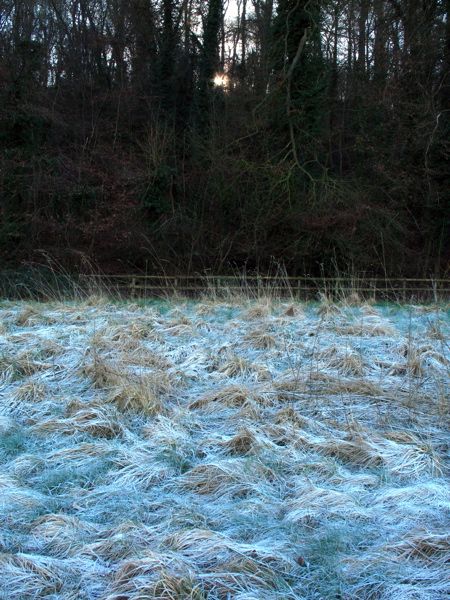
Frost under the hangar, Selborne 2007
- 1788: November 27, 1788 – Some light snow. Boys slide on lakes. Turned up much fine rotten earth from among the rubbish carryed out of the garden.
- 1786: November 27, 1786 – Grey crows on the downs.
- 1782: November 27, 1782 – Fierce frost. Rime hangs all day on the hanger. The hares, press’d by hunger, haunt the gardens & devour the pinks, cabbages, parsley, &c. Cats catch the red-breasts. Timothy the tortoise sleeps in the fruit-border under the wall, covered with a hen-coop, in which is a good armfull of straw. Here he will lie warm, secure, & dry. His back is partly covered with mould.
- 1781: November 27, 1781 – Began to use some of the advertised Celeri, which, I think, is crisper & finer flavoured than any sort that I have met with.
- 1778: November 27, 1778 – Finished trimming & tacking my vines: the wood is pretty well ripened for next year. Not withstanding the vehemence of last summer, & the lasting heat, yet my grapes were not so early nor so well ripened as in some moderate years. In particular in 1775 my crops began to be gathered the first week in Septemr: & were in high perfection all the autumn: whereas this year we could not gather at all ’til Octobr & then the flavour was not delicate & many clusters never ripened at all. A proof this that somewhat more is requisite in the production of fine fruits than mere heat. My peaches & nectarines also this summer were not in such perfection as in some former seasons.
- 1777: November 27, 1777 – Began planing the floor-battins for my new parlor: they are very fine, & without knots; 500 feet.
- 1773: November 27, 1775 – Arrangement of parts is both smell & color: thus a sweet, & lovely flower when bruized both stinks & looks ugly. We may add that arrangement of parts is also flavor: since muddled liquors & frozen meats immediately lose it.
- 1772: November 27, 1772 – Vast flocks of wild fowls in the forest. They are probably migraters newly arrived.
- 1771: November 27, 1771 – A large flock of red-wings, Turdus iliacus, appear.
- 1769: November 27, 1769 – Green-finches in a vast flock: them seem to feed on the seeds of echium vulgare.
Notes:
“Arrangement of parts” is an ancient convention of the philosophy of what makes something beautiful.. Googling the phrase turns up a lot of hits on David Hume, a near-contemporary of White’s. It’s intriguing to think of the clerical but empiricist White being influenced by Hume, but I’d need to read great deal more of Hume to make this assertion! Most likely the use of the phrase “arrangement of parts” is a product of their mutual education in the Greek philosophers.
Posted by sydney on Nov 26th, 2008
- 1792: November 26, 1792 – Timothy hides.
- 1791: November 26, 1791 – 3 gallons of brandy from London
- 1788: November 26, 1788 – Finished shovelling the zigzag, & bostal. Wildfowl on Wolmer-pond.
- 1787: November 26, 1787 – Monthly roses now in bloom.
- 1786: November 26, 1786 – Mr Cane saw in one flock some hundreds of whistling plovers on the downs.
- 1784: November 26, 1784 – Haws in such quantities that they weigh down the white-thorns.
- 1783: November 26, 1783 – The farmers have long since sown all their wheat, & ploughed-up most of their wheat-stubbles.
- 1782: November 26, 1782 – The woods, & hedges are beautifully fringed with snow. Ordered thomas carefully to beat-off the snow that lodges on the Sought side of the laurels & laurustines.
- 1781: November 26, 1781 – The planet Venus now is visible at Selborne over the hanger. Planted against the fruit-wall, three well-trained trees that are to begin to bear fruit next year: viz: 1 Peterboro’ nectarine N.E. end. 1 mantaban peach. 1 red Magdalen peach, against the scullery. 1 Elrouge Nectarine. These trees came from Mr Shiell’s nursery at Lambeth & cost 7s. 6d. on the spot. They have healthy wood, & well-trained heads. Planted a Virginian creeper against the wall of my house next the garden.
- 1776: November 26, 1776 – A man brought me a common sea-gull alive: three crows had got it down in a field, & were endeavouring to demolish it.
- 1775: November 26, 1775 – Very dark season: dark within doors a little after 3 o’clock in the afternoon.
- 1773: November 26, 1773 – A profusion of turneps probably all the kingdom over: on which account lean sheep are very dear. Hops at present lie on hand: were carried to Weyhill, then to Andover: & now are bringing home again. Snow gone except under hedges. Birds do not seem to touch the berries of the tamus cummunis ‘tho they look very red, & inviting: the berries also of the bryonia alba seem not to be meddled with. Perhaps they are too acrid. There is a fine crop of clover of last spring: the frequent showers of last summer occasioned also a vast growth of grass.
- 1772: November 26, 1772 – At Mr. Pink’s at Faringdon is a rook’s nest with young in it.
- 1771: November 26, 1771 – September-like weather. Footpaths dry like march.
- 1768: Novmeber 26, 1768 – Ice, fine day. Soft afternoon. Many gnats appear. A martin seen it was very brisk, & lively.
- 1768: November 26, 1768 – Ice, fine day. Soft afternoon. Many gnats appear. A martin seen: it was very brisk, & lively.
Posted by sydney on Nov 25th, 2008
- 1791: November 25, 1791 – Well rises very fast.
- 1785: November 25, 1785 – Mosses begin to grow, & look vivid; & will begin to blow in a few weeks.
- 1781: November 25, 1781 – Fog, wh. frost. As the fog cleared away, the warm sun occasioned a prodigious reek, or steam to arise from the thatched roofs. in the evening picturesque partial fogs come rolling-in up the Lithe from the forest.
- 1779: November 25, 1779 – Mrs Snooke’s old tortoise retired under the ground.
- 1777: November 25, 1777 – Men stack their turneps, a new fashion that prevails all at once; & sow the ground with wheat. They dung the fields in summer as for wheat.
- 1775: November 25, 1775 – Many phalanae appear. Strange that these nocturnal lepidoptera should be so alert, at a season when no day papilios appear, but have long been laid-up for the winter. Trees will not subsist in sharp currents of air: thus after I had opened a vista in the hedge at the E. corner of Baker’s hill, no tree that I could plant would grow in that corner: & since I have opened a view from the bottom of the same field into the mead, the ash that grew in the hedge, & now stands naked on the bastion, is dying by inches, & losing all it’s boughs. Phalaene appear about hedges in the night time the winter thro’.
- 1773: November 25, 1773 – Considerable snow on the ground.
- 1772: November 24, 1772 – Nasturtiums nipped but still in bloom.
- 1770: November 25, 1770 – Linnets flock in prodigious numbers.
Posted by sydney on Nov 24th, 2008
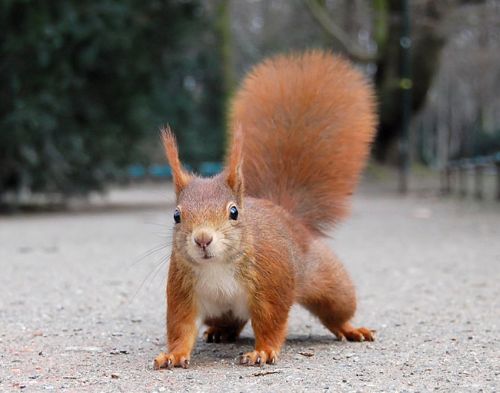
Red squirrel, photo by Ray Eye.
- 1792: November 24, 1792 – Saw a squirrel in Baker’s hill: it was very tame. This was probably what Thomas called a pole-cat.
- 1789: November 24, 1789 – The miller supplies us with cold, damp flour, & says he can get no other: he adds, that the best wheat is at the bottom of the mows, & will not come forth till the spring. The latter part of the wheat harvest was very wet.
- 1788: November 24, 1788 – Liss hounds are hunting on the common. My well very low: some wells are dry. We have taken away much of the old wood from the vines. Wheeled dung.
- 1781: November 24, 1781 – Cascades fall from the fields into the hollow lanes.
- 1777: November 24, 1777 – Gathered in all the grapes for fear of the frost. We have now enjoyed a dry good season, with no more rain than has been useful, ever since the first week of August.
- 1775: November 24, 1775 – A flight of woodcocks about in the country.
- 1773: November 24, 1773 – Finished the levelling, & turfing of garden. The alteration has a good effect. The weather & rains considered, the turf lies pretty well.
- 1770: November 24, 1770 – The wood-pigeon, or stock-dove begins to appear. they leave us all to a bird in the spring, & do not breed in these parts; perhaps not in this island. If they are birds of passage, they are the last winter bird of passage that appears. The numbers that come to these parts are strangely diminished within these twenty years. For about that distance of time such multitudes used to be observed, as they went to & from roost, that they filled the air for a mile together: but now seldom are more than 40 or 50 anywhere to be seen. They feed on acorns, beech mast, & turneps. They are much smaller than the ring-dove, which stays with us all the year.
Notes:
Thomas was Gilbert White’s manservant, frequently mentioned in these pages. The squirrel/poleccat sighting is recorded on October 28. The noting of a squirrel as a rare and novel animal demonstrates the boom and bust of the red squirrel’s (Sciurus vulgaris) fortunes. According to Oliver Rackham’s invaluable History of the Countryside, they became much more common towards the end of the nineteenth century as more conifers were planted, declining sharply again with the introduction of the grey squirrel.
The classification of pigeon/dove species seems to have shifted since White’s time. ‘Wood Pigeon’ now refers to the same bird as ‘Ring Dove’, Columba polumbas, instantly recognizable for its large size and loud sobbing coo. The smaller bird White notes down is known only by ‘Stock dove’ now, Columba oenas. It is a migrant in its Northern ranges according to Wikipedia. Here is an excellent guide to distinguishing British pigeons.
EDITED TO ADD: Apologies for the incorrect link to the pigeon site.
Posted by sydney on Nov 23rd, 2008
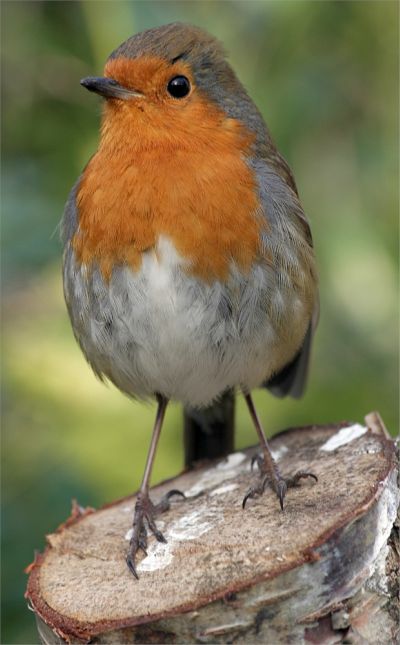
European robin, photo by David Jordan courtesy of Wikipedia. These little birds are so tame I nearly stepped on one yesterday; they like to hang around hiking trails in wet weather in hope of worms.
- 1790: November 23, 1790 – The water in my well is risen three or four rounds of the winch, viz. five or six feet: the spring that runs in may be seen, & heard. The water is now clear. Thus will three or four inches of rain replenish my well, deep as it is, after it has been very low, & foul, & almost dry for several months. I have made the same remark in former years. Our stream has been so low for many weeks that the miller at Kingsley could not grind; but was obliged to send his corn to Headleigh, where the Blackdown stream never fails. At Headleigh park-corner the Blackdown streams joins the Selborne rivulet: & at Tilford bridge they are met by the Farnham river, where together they form so considerable a body of water as within a few miles to become navigable, viz: at the town of Godalming; & there take the name of Wey.
- 1788: November 23, 1788 – The downy seeds of travellers joy fill the air, & driving before a gale appear like insects on the wing. Mrs Clement brought to bed of a boy. My nephews & nieces now 53.
- 1784: November 23, 1784 – Brother Thomas, & his daughter, & two sons came. The chaise that brought some of them passed along the king’s high road into the village by Newton lane, & down the N. field hill; both of which have had much labour bestowed on them, & are now very safe. This is the first carriage that ever came this way. Planted tulips again in the borders; & the small off-sets in a nursery-bed.
- 1783: November 23, 1783 – The stream in Gracious-street runs, after having been dry for many months.
- 1780: November 23, 1780 – Multitudes of Starlings appear at Newton, & run feeding about in the grass-fields. No number is known to breed in these parts. This is therefore an emigration from some other district.
- 1779: November 23, 1779 – Total eclipse of the moon, total but not central.
- 1775: November 23, 1775 – The high glass brings no good weather: Baromrs usually dote, & are mistaken about this time of year.
- 1773: November 23, 1773 – While my people move earth in the garden the redbreasts in pursuit of worms are very tame, & familiar, settling on the very wheel-barrows, while filling.
- 1771: November 23, 1771 – Turdus pilaris. Hardly any field-fares appear: there are no haws.
- 1768: November 23, 1768 – The ground in a sad drowned condition. The low fallows can never be sowed.
Posted by sydney on Nov 22nd, 2008
- 1792: November 22, 1792 – Timothy comes forth.
- 1788: November 22, 1788 – The smoke of the new lighted lime-kilns this evening crept along the ground in long trails: a token of a dry, heavy atmosphere.
- 1787: November 22, 1787 – Housed all the billet-wood in dry, good order. Covered the lettuce under the fruit-wall with straw.
- 1786: November 22, 1786 – I sent a woman up the hill with a peck of beech-mast which she tells me she has scattered all round the down amidst the bushes & brakes, where there were no beeches before. I also ordered Thomas to sow beech-mast in the hedges all round Baker’s-hill.
- 1780: November 22, 1780 – Some animal eats off the pinks.
- 1777: November 22, 1777 – Beeches love to grow in crouded situations, & will insinuate themselves thro’ the thickest covert, so as to surmount it all. Are therefore proper to mend thin places in tall hedges. Strong N. aurora, extending to the W. and S.W. some streaks of fiery red.
- 1776: November 22, 1776 – The ground was covered with snow at Buxton in Derbyshire.
- 1774: November 22, 1774 – London. When I came to town I found that herrings were out of season, but sprats, which Ray says are undoubtedly young herrings, abounded in such quantities, that in these hard times they were a great help to the poor. Cods & haddocks in plenty: smelts beginning to come in. The public papers here abounded with accounts of most severe & early frosts, not only in the more Northern parts of Europe, but on the Rhine, & in Holland. The news of severe weather usually reaches us some days before the cold arrives; which most times follows soon when we hear of rigorous cold on the Continent.
- 1773: November 22, 1773 – Beautiful rimes all day on the hanger.
- 1768: November 22, 1768 – The barometer unusually low considering there is little wind. The astonishing fall of the glass was remarked all the kingdom over: we had no wind, & not much rain, ; only vast swagging rock-like clouds appear’d at a distance.
Posted by sydney on Nov 21st, 2008
- 1792: November 21, 1792 – Sent 3 bantam fowls to Miss Reb. White at Mareland, a cock & two pullets.
- 1790: November 21, 1790 – A vast tempest at Sarum; & an house beat down. The mast of a man of war was struck at Spit-head by the lightening.
- 1786: November 21, 1786 – Bought 61 bushels of peat-ashes, & laid them up in the ash-house.
- 1785: November 21, 1785 – Partridges associate in vast coveys.
- 1782: November 21, 1782 – The conjunction of Jupiter & Saturn is over; & the former, which lately was just below the latter, is now to the E. of him, & in a line parallel with the horizon. These planets are so near the sun at setting as to be visible but a small time: & are so low as not to be seen at all at Selborne, because of the hill.
- 1781: November 21, 1781 – Finished dressing the vines. The new wood was small, & not highly ripened; so it was laid-in the shorter. It covers the walls regularly.
- 1777: November 21, 1777 – Planted a number of small beeches in the tall hedges.
- 1776: November 21, 1776 – The thatch is torn by the wind.
- 1773: November 21, 1773 – Yellow water wagtail.
Posted by sydney on Nov 20th, 2008
Posted by sydney on Nov 19th, 2008
- 1792: November 19, 1792 – Water-cress comes in.
- 1788: November 19, 1788 – Mr. Hale continues to chalk the black malm field opposite to J. Berriman’s house, called Hasteds. He has laid on about 120 loads on less than 3 acres.
- 1785: November 19, 1785 – Harry Holt White left us, & went to Fyfield.
- 1782: November 1782 – One way or other we have used most of the grapes.
- 1781: November 19, 1781 – Planted two Cypresses in the garden. They came from S. Lambeth.
- 1776: November 19, 1776 – This afternoon the weather turning suddenly very warm produced an unusual appearance; for the dew on the windows was on the outside of the glass, the air being warmer abroad than within.
- 1773: November 19, 1773 – Ring-ouzels still remain. Gathered in the last grapes: ye crop was very large, & the grapes delicate. And yet the vine-shoots were much pinched at their tops by frost the first week in May; & more-over Septemr was a season of continual clouds & rain. Ring-ouzels, & stone-curlews stay late with us this year.
- 1771: November 19, 1771 – Hen chaffinches begin to congregate.
- 1769: November 19, 1769 – Bearing ice.
- 1768: November 19, 1768 – Many sorts of flies still appear, the musca carnaria, meridiana, tenax, &c.
 Theme Ported to