Posted by sydney on Oct 4th, 2008
- 1790: October 4, 1790 – Three martin’s nests at Mr Burbey’s are now full of young!
- 1789: October 4, 1789 – The breed of hares is great: last year there were few. Some have remarked that hared abound most in wet summers.
- 1788: October 4, 1788 – Fyfield, the spaniel, rejects the bones of a wood-cock with horror. Gathered in the non-pareils. The prodigious crop of apples this year verified in some measure the words of Virgil made use of in the description of the Corycian garden;
“Quotq’ in flore novo pomis se fertilis arbos/Induerat, totidem in autumno matura tenebat.”
- 1786: October 4, 1786 – On this day an woodcock was seen in a coppice at Froyle. Gathered-in the Royal-russets, & knobbed russets; the former are fine shewy apples. There is a good crop of each sort.
- 1785: October 4, 1785 – Bror. Henry comes.
- 1783: October 4, 1783 – This day has been at Selborne the honey market: for a person from Chert came over with a cart, to whom all the villagers round about brought their hives, & sold their contents. This year has proved a good one to the upland bee-gardens, but not to those near the forest. Combs were sold last year at about 3 3/4d per pound; this year from 3 1/2-4d. Women pick up acorns, & sell them for 1s pr bushel. A splendid meteor seen at half hour past six in the evening; but not so large as that on the 18th of August.
- 1782: October 4, 1782 – Numbers of pheasants at Inne down-coppice.
- 1781: October 4, 1781 – No h. martins, nor swallows in the village, nor sand-martins about the forest. Ld Stawel was fishing Wolmer-pond with a long net drawn by ten men.
- 1779: October 4, 1779 – Mushrooms abound. Made catchup.
- 1775: October 4, 1775 – One swallow. What can this bird be doing behind by itself? Why might they not have all staid, since this individual seems brisk, & vigorous.
- 1773: October 4, 1773 – Vetches & pease are mostly spoiled. Martins. Mr Yalden has 10 acres of barley abroad.
- 1770: October 4, 1770 – Ring-ouzels near Ringmer. Swallows abound.
- 1768: October 4, 1768 – Grapes are good. The ash and mulberry cast their leaves.
Posted by sydney on Oct 3rd, 2008
<
Venator: My friend Piscator, you have kept time with my thoughts; for the sun is just rising, and I myself just now come to this place, and the dogs have just now put down an Otter. Look ! down at the bottom of the
hill there, in that meadow, chequered with water-lilies and lady-smocks; there you may see what work they make; look! look! you may see all busy; men and dogs; dogs and men; all busy.–Izaak Walton, The Compleat Angler, 1653
Engraving by Thomas Bewick (the otter is in the lower right corner; click on the image for a larger version.) Otters, like nearly all predators competitive with man, were mercilessly hunted. An excellent if depressing book on the destruction of wildlife in this era, so in evidence in White’s journals, is Silent Fields, by the aptly named Roger Lovegrove.
- 1792: October 3, 1792 – Hirundines swarm around the Plestor, & up & down the street.
- 1790: October 3, 1790 – The row of ten weeks stocks under the fruit-wall makes a beautiful show.
- 1789: October 3, 1789 – Gathered in burgamot, & Creson burgamot pears. Gathered some grapes, but they are not good. B. Th. White sowed two pounds of furze-seed from Ireland on the naked part of the hanger. The furze-seed sown by him on the same space in May last is come-up well.
- 1787: October 3, 1787 – Men sow wheat; but wish for more rain to moisten their fallows. The quantity of potatoes planted in this parish was very great, & the produce, on ground unused to that root, prodigious. David Long had two hundred bushels on half an acre. Red or hog potatoes are sold for six pence pr bushel. Mr Churton left us & went to Waverley: Nep. Tom & Harry left us, & went to Fyfield.
- 1786: October 3, 1786 – Gathered-in the apples called dearlings, which keep well, & are valuable kitchen apples. My only tree of the sort stands in the meadow, & produced ten bushels of fruit. Apples this year have sold at 8s per bushel: so had the price continued the produce would be worth four pounds. Next year probably there will be no crop; because I do not remember to have seen this tree bear two years following.
- 1784: October 3, 1784 – Two young men killed a large male otter, weighing 21 pounds, on the bank of our rivulte, below Priory longmead, on the Hartely-wood side, where the two parishes are divided by the stream. This is the first of the kind ever remembered to have been found in this parish.
- 1783: October 3, 1783 – The hanger is beatifully tinged. Leaves fall apace. Dug up carrots. Many flesh-flies: here & there a wasp. The cat frolicks, & plays with the falling leaves.
- 1782: October 3, 1782 – Rain 78 in my garden, on the tower 59.
- 1781: October 3, 1781 – Bought a bay-Welch Galloway mare. Out of the horses that were offered to me to try, there were ten mares to one gelding.
- 1780: October 3, 1780 – No ring-ouzels seen this autumn yet. Timothy very dull.
- 1779: October 3, 1779 – Began lighting fires in the parlor.
- 1778: October 3, 1778 – White low fogs over the brooks.
- 1777: October 3, 1777 – What becomes of those massy clouds that often incumber the atmosphere in the day, & yet disappear in the evening. Do they melt down into dew? * Some of the store wethers on this down now prove fat, & weigh 15 pounds a quarter. This incident never befals but in long dry seasons; & then the mutton has a delicate flavour.
- 1776: October 3, 1776 – Beautiful wheat season for the wet fallows. The buzzard is a dastardly bird, & beaten not only by the raven, but even by the carrion-crow. Gathered baking-pears.
- 1774: October 3, 1774 – Gathered in the more choice pears, Autumn burgamots, chaumontels, &c.; a good crop.
- 1773: October 3, 1773 – Grey, dark showers, dry & windy. Glass falls at a vast rate.
- 1771: October 3, 1771 – Grapes turn black. Vetches, & seed-clover housed. Baromr sinks very fast. Ring-ouzels. Ring-ouzels affect to perch on the top twigs of tall trees, like field-fares. When they flie off they chatter like black birds. Apples are gathering.
- 1770: October 3, 1770 – Ring-ouzels again on the downs eastward.
Posted by sydney on Oct 2nd, 2008

The painting mentioned in the 1790 entry was reproduced in a posthumous collection of White’s journals published by his brothers in 1795. This is scanned from my own copy;click on the image to see it larger.
- 1792: October 2, 1792 – Flying ants, male & female, usually swarm, & migrate on hot sunny days in August & Septembr; but this day a vast emigration took place in my garden & myriads came forth in appearance, from the drain which goes under the fruit-wall; filling the air & adjoining trees & shrubs with their numbers. The females were full of eggs. This late swarming is probably owing to the backward, wet season. The day following, not one flying ant was to be seen. The males, it is supposed all perish: the females wander away; & such as escape the Hirundines get into the grass, & under stones, & tiles, & lay the foundation of future colonies.
- 1791: October 2, 1791 – Gathered one fine nectarine, the last. My double-bearing raspberries produce a good crop. Grapes very fine, endive good.
- 1790: October 2, 1790 – Bro. Thomas, & his daughter Mrs Ben White left us, & went to London. Lord Stawell sent me from the great Lodge in the Holt a curious bird for my inspection. It was found by the spaniels of one of the keepers in a coppice, & shot on the wing. The shape, & air, & habit of the bird, & the scarlet ring round the eyes, agreed well with the appearance of a cock pheasant; but then the head & neck, & breast & belly, were of a glossy black: & tho’ it weighed 3 ae 3 1/2 oun., the weight of a large full-grown cock pheasant, yet there were no signs of any spurs on the legs, as is usual with all grown cock pheasants, who have long ones. the legs & feet were naked of feathers; & therefore it could be nothing of the Grous kind. In the tail were no long bending feathers, such as cock pheasants usually have, & are characteristic of the sex. The tail was much shorter than the tail of an hen pheasant, & blunt & square at the end. The back, wing-feathers, & tail, were all of a pale russet, curiously streaked, somewhat like the upper parts of an hen partridge. I returned it to the noble sender with my verdict, that it was probably a spurious or hen bird, bred between a cock pheasant and some demestic fowl. When I came to talk with the keeper who brought it, he told me, that some Pea-hens had been known last summer to haunt the coppices & coverts where this mule was found. *Hen pheasants usually weigh only 2 ae 1 oun. My advice was that his Lordship would employ Elmer of Farnham, the famous game-painter, to take an exact copy of this curious bird. — His Lordship did employ Elmer, & sent me as a present a good painting of that rare bird.
- 1788: October 2, 1788 – Gathered six bush. & half of dearlings from the meadow-tree: four or five bush. remain on the tree. The foliage of the Virginian creeper of a fine blood-colour.
- 1783: October 2, 1783 – Erected an alcove in the middle of the bostal. Charles Henry White, & his sister Bessey returned to Fyfield.
- 1780: October 2, 1780 – Cleaned-out the zigzag. The spinage sown in Aug. now in perfection.
- 1778: October 2, 1778 – Timothy, the old tortoise, weighed six pounds, & eleven ounces averdupoise.
- 1775: October 2, 1775 – The barometer falls with great precipitation.
- 1773: October 2, 1773 – Swallows do not resort to chimnies for some time before they retire. Titlarks abound on the common. Martins are the shortest-winged & least agile of all the swallow-tribe. They take their prey in a middle region, not so high as the swifts: nor do they usually sweep the ground so low as the swallows. Breed the latest of all the swallow genus: last year they had young nestlings on to the 21 of Octr. They usually stay later than their congeners. Lat year 20 or 30 were playing all day long by the side of the hanger, & over my fields on Novr. 3rd. After that they were seen no more.
- 1771: October 2, 1771 – Woodlark whistles. Few swallows. One martin’s nest with young in it. Some few martins about.
- 1770: October 2, 1770 – Ring-ouzel on Harting Hills.
- 1768: October 2, 1768 – Swallows still. Glow-worms shine.
Posted by sydney on Oct 1st, 2008
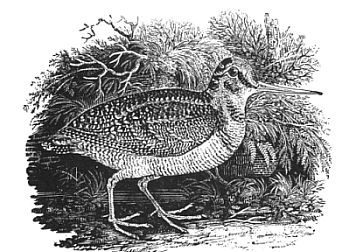
Woodcock, Thomas Bewick’s History of British Birds, 1797
- 1792: October 1, 1792 – Wheat out at Buriton, Froxfield, Ropely, & other places.
- 1791: October 1, 1791 – Nep. B. White left us, & went to London. It was with difficulty that we procured water enough for brewing from my well.
- 1788: October 1, 1788 – H.H. White came from Fyfield.
- 1787: October 1, 1787 – Wheat not so good as last year: 50 sheaves do not yield more than forty did this time twelvemonth.
- 1786: October 1, 1786 – About Octobr 1, the weather was cold & wet at Vevey, in Switzerland; when the Hirundines flew so near the ground as to be a prey to cats, which watched for them; & some entered mens windows so tame & hungry as to sit on a finger, & take flies when offered to them, or which they saw on the glass or walls.
- 1784: October 1, 1784 – Gathered-in the Swan’s egg, autumn-burgamot, Cresan-burgamot, Chautmontelle, & Virgoleuse pears: a great crop. The Swan-eggs are a vast crop. A wood-cock was killed in Blackmoor-woods; an other was seen the same evening in Hartley-wood.
- 1781: October 1, 1781 – Cleaned my well by drawing out about 100 buckets of muddy water: there was little rubbish at the bottom. There were two good springs, one at the bottom, & one about three feet above. Nothing had been done to this well for about 40 years. The man at the bottom in the cleaning brought up several marbles & taws that we had thrown down when children.
- 1777: October 1, 1777 – Bright stars. This day, Mr Richardson of Bramshot shot a wood-cock: it was large & plump & a female: it lay in a moorish piece of ground. This bird was sent to London, where as the porter carryed it along the streets he was offered a guinea for it.
- 1776: October 1, 1776 – Swallows & martins, before they withdraw, not only forsake houses, but do not frequent the villages at all: so that their intercourse with houses is only for the sake of breeding.
- 1772: October 1, 1772 – Young martins in their nest at Lassam.
- 1768: October 1, 1768 – Harvest pretty well finished this evening. Some wheat out at Harting. Roads are much dryed.
Posted by sydney on Sep 30th, 2008
- 1792: September 30, 1792 – There is a remarkable hill on the downs near Lewes in Susses, known by the name of Mount Carburn, which over-looks that town, & affords a most engaging prospect of all the country round, besides several views of the sea. On the very summit of this exalted promontory, & amidst the trenched of its Danish camp, there haunts a species of wild Bee, making it’s nest in the chalk soil. When people approach the place, these insects begin to be alarmed, & with a sharp & hotile sound dash, & strike round the heads & faces of intruders. I have often been interrupted myself while contemplating the grandeur of the scenery around me, & have thought myself in danger of being stung:– and have heard my Brother Benjamin say, that he & his daughter Rebecca were driven from the spot by the fierce menaces of these angry insects. In old days Mr Hay of Glynd Bourn, the Author of Deformity, & other works, wrote a loco-descriptive poem on the beauties of Mount Carburn.
- 1790: September 30, 1790 – Cut 81 cucumbers. On this day Mrs Brown was brought to bed at Stamford of twins, making my nephews & nieces 58 in number. The night following this poor, dear woman dyed, leaving behind her nine young children.
- 1788: September 30, 1788 – Gathered such of the Cadillac pears, as could readily be reached by ladders. Thomas says there are 13 bushels on my only tree.
- 1785: September 30, 1785 – Will Tanner thinks he saw in the high wood marks where a wood-cock had been boring. Mr Barker, who rode this day to Rake, Rogate, & Furley-hill, saw much grass, & clover cut, & cutting. Some barley out.
- 1783: September 30, 1783 – Lovely weather, red even. True Michaelmas summer.
- 1782: September 30, 1782 – Many wasps at Lydon in Rutland, tho’ none in the great heats of autumn 1781. So there is some mystery in their breeding that we do not understand. * At the autumnal aequinox, the evenings are remarkably dark, because the sun at that time sets more in a right angle to the horizon, than at any other season. But of late these uncomfortable glooms have been much softened by frequent N. Auroras. This circumstance of autumnal darkness did not escape the poet of nature: who says,
“Now black, & deep the night begins to fall,/A shade immense. Sunk in the quenching gloom/Magnificent & vast are heaven & earth/Order confounded lies; all beauty void;/Distinction lost; & gay variety/One universal blot: such the fair powerOf light, to kindle, & create the whole.”
Thompson’s Autumn
- 1781: September 30, 1781 – Men put-up their hogs to fat. House-flies muscae domesticae, now croud about the fire-place, run on hearths, & sport in the chimney-corner.
- 1774: September 30, 1774 – Rooks begin to frequent the wall-nut & carry-off the fruit.
- 1773: September 30, 1773 – Some barley abroad that has been cut a month. Earwigs cast their skins & come forth white. 10 or 12 ring-ouzels appear on their autumn migration round Noar hill. Martins are seldom seen at any distance from neighbourhoods. They feed over waters or under the shelter of an hanging wood. Swallows often hawk about on naked downs & fields, even in very windy seasons at a great distance from houses.
- 1769: September 30, 1769 – The ring-ouzels, merulae torquatae, are most punctual about their migration, & appear again in a considerable flock.
- 1768: September 30, 1768 – Stares flock at Chilgrove. Oedicnemus does not flock yet.
Posted by sydney on Sep 29th, 2008
- 1791: September 29, 1791 – A gale rises every morning at ten o’ the clock & falls at sunset.
- 1789: September 29, 1789 – Swallows not seen: they withdraw in bad weather, & perhaps sleep most of their time away like dogs & cats, who have a power of accululating rest, when the season does not permit them to be active.
- 1788: September 29, 1788 – Mr Churton left us. T.H. White came from Fyfield.
- 1787: September 29, 1787 – Vast flock of ravens on the down.
- 1784: September 29, 1784 – Took possession of Selborne curacy.
- 1783: September 29, 1783 – Gathered-in the apples, knobbed russets, & non-pareils. Royal russets none. All the baking pears were blown down. No dearlings.
- 1782: September 29, 1782 – It is remarkable that this wet cold weather produces no good mushrooms. A great plenty of the pale, coarse sort appeared early in the autumn, but I have seen none with the salmon-coloured laminae, wich are the only edible sort.
- 1781: September 29, 1781 – My well has now only three feet in water: it has never been so low, since my father sunk it, more than forty years ago.
- 1778: September 29, 1778 – Herrings come into season. The after-grass in this grazing-country is very short, & scanty.
- 1776: September 29, 1776 – Nothing left abroad but seed-clover, & a few beans.
- 1774: September 29, 1774 – Hops in some places not yet gathered. Grapes begin to be good: the crop is scanty, & the branches & berries small.
- 1773: September 29, 1773 – Multitudes of martins, but I think not many swallows. Grapes are eatable, but not curious yet; are damaged by the wasps.
- 1771: September 29, 1771 – Woodcock, Scolopax, appears early. Glow-worms shine.
- 1769: September 29, 1769 – Swallows and martins all the way on the downs.
- 1768: September 29, 1768 – Swallows cluster on the bushes in the barnet. Redstart.
Posted by sydney on Sep 28th, 2008
- 1791: September 28, 1791 – Linnets congregate in great flocks. This sweet autumnal weather has lasted three weeks, from Septr. 8th.
- 1785: September 28, 1785 – Several ring-ouzels on Nore hill. Farmer Tull mows mill-mead, a second crop, which it is expected will prduce near 3 tuns on an acre. Men mow also clover, hoping to get some hay at last. Timothy the tortoise spends all the summer in the quarters of the kitchen-garden among the asparagus, &c. but as soon as the first frosty mornings begin, he comes forth to the laurel-hedge, by the side of which he spends the day, & retires under it at night; ’till urged by the encreasing cold he buries himself in Novr amidst the laurel-hedge.
- 1781: September 28, 1781 – Dug up potatoes, & carrots.
- 1780: September 28, 1780 – The China hollycocks in my strong soil grow too tall, & are just beginning to blow. Began to light fires in the parlor.
- 1779: September 28, 1779 – Grapes are rich, & sweet.
- 1774: September 28, 1774 – All things in a drowning condition!
- 1773: September 28, 1773 – Stoparola, flycatcher, still appears.
- 1772: September 28, 1772 – Swallows & martins. Gathered the first grapes: large & good.
- 1768: September 28, 1768 – These ring-ouzels are seen again in the spring in their return to the north.
Posted by sydney on Sep 27th, 2008
- 1792: September 27, 1792 – Strong, cold gale.
- 1790: September 27, 1790 – The innoculated at Hartley sicken.
- 1789: September 27, 1789 – A man brought me a land-rail or daker-hen, a bird so rare in this district, that we seldom see more than one or two in a season, & those only in autumn. This is deemed a bird of passage by all the writers; yet from it’s formation seems to be poorly qualifyed for migration; for its wings are short, & placed so forward, & out of the center of gravity, that it flies in a very heavy & embarrassed manner, with it’s legs hanging down; & can hardly be sprung a second time, as it runs very fast, & seems to depend more on the swiftness of it’s feet than on it’s flying. When we came to draw it, we found the entrails so soft & tender, that inappearance they might have been dressed like the ropes of an woodcock. The craw or crop was small & lank, containing a mucus; the gizzard thick & strong, & filled with many shell-snails, some whole, & many ground to pieces thro’ the attrition which is occasioned by the muscular force & motion of that intestine. We saw no gravels among the food: perhaps the shell-snails might perform the functions of gravels or pebbles, & might grind one another. Land-rails used to abound formerly, I remember, in the low, wet bean-fields of Xtian Malford in North Wilts; & in the meadows near Paradise-Gardens at Oxford, where I have often heard them cry Crex, Crex. The bird mentioned above weighed seven ounces & an half, was fat & tender, & in flavour like thesh of a woodcock. The liver was very large & delicate.
- 1785: September 27, 1785 – My well, notwithstanding the rains is very low still, so that we let out all the rope to draw a bucket of water.
- 1784: September 27, 1784 – Nep. Ben White left me: me stayed a few days.
- 1782: September 27, 1782 – Bro. Thomas White, his daughter, & two sons left Selborne.
- 1781: September 27, 1781 – Gathered-in Cadilliac-pears, dearlings, & royal russets.
- 1780: September 27, 1780 – Finished a Bostal, or sloping path up the hanger from the foot of the zigzag to the corner of the Wadden, in length 414 yards. A fine romantic walk, shady & beautiful. In digging along the hanger the labourers found many pyrites perfectly round, lying in the clay; & in the chalk below several large cornua Ammonis.
- 1779: September 27, 1779 – Gathered-in the pears. The Cardillac-tree bore five bushels. Apples are few; & the crop of grapes small.
- 1777: September 27, 1777 – Distant lightening. We had but little rain, only the skirts of the storm. The dry weather, which was of infinite service to the country after so wet a summer, might fairly be said to last eight weeks: three of which had no rain at all, & much sun-shine.
- 1775: September 27, 1775 – Gathered-in the royal russets, & knobbed russets. Tyed-up endive. *My Arundo donax, which I receied from Gibraltar, is grown this year eight or nine feet high: I therefore opened the head of one stalk to see what approaches it had made towards blowing after so hot a summer. When it was cut open we found a long series of leaves enfolded one within the other to a most minute degree, but not the least rudiments of fructification; so that the plant must have extended itself many feet before it could have attained to it’s full stature: and must have required many more weeks of hot weather before it could have brought any seeds to maturity.
- 1774: September 27, 1774 – Mr Yalden mows a field of barley. Much barley abroad.
- 1773: September 27, 1773 – Gathered the last nectarines: very good. Large aurora: very vivid in the S.W.
- 1771: September 27, 1771 – Black cap. Few martins over oak-hanger ponds. Woodlark whistles.
- 1770: September 27, 1770 – Gardens are torn to pieces, & great boughs off trees.
- 1768: September 27, 1768 – People are now housing corn after 27 days interruption.
Posted by sydney on Sep 26th, 2008
- 1791: September 26, 1791 – My potatoes come in, and are good.
- 1789: September 26, 1789 – Multitudes of Hirundines. Sweet Mich. weather.
- 1787: September 26, 1787 – Many ravens on the hill, & a flight of starlings.
- 1786: September 26, 1786 – Saw a nest full of young swallows, nearly fledged, in their nest under Captain Dumaresq’gate way at Pilham-place. Saw the same day many martins over Selborne village. I have often seen young house-martins in their nests in the Mich. week; but never swallows before.
- 1784: September 26, 1784 – Mr Taylor took possession of Selborne vicarage.
- 1781: September 26, 1781 – Dug up potatoes: earthed up celeri. Gathered knobbed russetings, a large crop. Our building-sand from Wolmer-forest seems pure from dirt: but examined thro’ a microscope proves not to be sharp, & angular, but smooth as from collision. It is of a yellow colour. “The amazing number of swallows that at this time are flying in London, is a very uncommon appearance. They seem greatly affected by the severe cold weather we have experienced for some days past, since the wind has been northerly; they fly in at windows, & are so tamed or numbed, that boys beat them down, as they fly in the streets.” The Gazetteer
- 1780: September 26, 1780 – Moles live in the middle of the hanger.
- 1778: September 26, 1778 – Mrs Snooke has gathered-in all her apples, & pears: her fruit is finely flavoured in such hot years. Mrs Snooke’s black grapes begin to ripen. No wasps here. The distress in this place for want of water is very great: they have few wells in this deep loam; & the little pits & ponds are all dry; so that the neighbours all come for water to Mrs Snooke’s ponds.
- 1775: September 26, 1775 – Gathered in the golden-rennets. Apples are too large from the much wet.
- 1774: September 26, 1774 – Planted numbers of brown Dutch lettuces under the fruit-wall to stand the winter. *These proved very fine the spring following.
- 1772: September 26, 1772 – Apples & pears large & fine. Chilly air. Swallows and martins. The tempest on thursday night did considerable damage in London, & at Oxford, & in many parts of the kingdom.
- 1771: September 26, 1771 – Ring-ouzels, merula torquata, begin to apear on their autumnal migration.
- 1770: September 26, 1770 – Annuals are spoiled in the gardens.
- 1769: September 26, 1769 – Sweet day. The sheep about Lewes are all without Horns: & have black faces & legs. Sheep have horns & white faces again west of Bramber.
- 1768: September 26, 1768 – I saw a small Ichneumon-fly laying its eggs on, or in the aurelia of a papilio.
Posted by sydney on Sep 25th, 2008
- 1792: September 26, 1792 – Men begin to bag hops. Celeri comes in. Vine-leaves turn purple.
- 1791: September 25, 1791 – Several wells in the village are dry: my well is very low; Burbey’s Turner’s, Dan Loe’s hold out well.
- 1790: September 25, 1790 – A vast flock of lapwings, which has forsaken the moors & bogs, now frequents the uplands. Some ring-ouzels were seen round Nore-hill.
- 1789: September 25, 1789 – Men bag their hops; & house seed-clover. A fern-owl plays round the Plestor. As we were walking this day, Sept. 22nd: being the King’s coronation, on Nore-hill at one o’ the clock in the afternoon, we heard great guns on each side of us, viz. from the S. & from the N.E., which undoubtedly were the cannons of Portsmouth & Windsor: the former of which is at least 26 miles distant, & the latter 30. If the guns heard from the N.E. were not from Windsor, they must be those of the Tower of London.
- 1786: September 25, 1786 – Niece Betsey came from Fyfield.
- 1785: September 25, 1785 – Vast rain. Violent current in the street.
- 1784: September 25, 1784 – Sister Henry White, & her daughter came.
- 1783: September 25, 1783 – My wall-nut tree near the stable, which is usually barren, produces this year 5, or 600 nuts: the sort is very fine. The vast tree at the bottom of the garden bears every year, but the nuts are bad. Charles White, & Harry Woods came from Fyfield.
- 1782: September 25, 1782 – Sad hop, & harvest weather.
- 1781: September 25, 1781 – Gathered swan’s egg pears, a large crop. Surprising Auroras, very red in the W!!! The young swarms of bees this summer are light; the old stocks are heavy.
- 1780: September 25, 1780 – When people walk in a deep white fog by night with a lanthorn, if they will turn their backs to the light they will see their shades impressed on the fog in rude, gigantic proportions. This phenomenon seems not to have been attended to; but implies the great density of the meteor that juncture.
- 1779: September 25, 1779 – Full moon. No mushrooms have appeared all this month. I find that the best crop is usually in Aug. & if they are not taken then, the season catchup is lost. Many other fungi.
- 1776: September 25, 1776 – Fine young clover & fine turneps about the country. * The quantities of haws, & sloes this year are prodigious. Those hives of bees that have been taken have proved deficient in wax, & honey. In shady wet summers bees can scarce procure a store sufficient to carry them thro’ the winter: if not fed they perish.
- 1775: September 25, 1775 – Gathered-in the swan’s eggs, & autumn burgamot-pears: a vast crop of the former.
- 1774: September 25, 1774 – Wood-lark sings.
- 1773: September 25, 1773 – Much barley abroad. Wet fit ever since the first of Sepr. Wall-fruit fine still.
- 1772: September 25, 1772 – Vast tempest in the night that b roke boughs from the trees, & blowed down much of the apples & pears. Gathered some apples.
- 1771: September 25, 1771 – Hedge-sparrow begins its winter note.
- 1770: September 25, 1770 – Barley grows in the swarth. Thunder, lightening, hail.
- 1768: September 25, 1768 – A few of these rare birds (rock-ouzels) appeared, just this time twelve months, in orchards about yew-trees. I have not been able yet to procure a cock.
 Theme Ported to