Posted by sydney on Sep 24th, 2008
- 1791: September 24, 1791 – Young martins, & swallows come-out, & are fed flying. Endive well-blanched comes in. Bottled-off half hogsh. of port wine. The port ran elevn doz. & 7 bottles. Nep. Ben White & wife, & little Ben, came.
- 1790: September 24, 1790 – Thomas cut 130 cucumbers.
- 1789: September 24, 1789 – Mr & Mrs Ben White came from London.
- 1787: September 24, 1787 – Many swallows, & some bank-martins at Oakhanger-ponds. A multitude of swallows at Benes-pond; and some few house-martins, which probably roost in the willows at the tail of that pond. The swallows washed much; a sure sign that rain was at hand.
- 1786: September 24, 1786 – Dame Loe came.
- 1785: September 24, 1785 – Bror. Henry left us.
- 1781: September 24, 1781 – The wind blows down apples and pears. Vivid aurora.
- 1778: September 24, 1778 – No stone-curlews congregate this autumn at Chilgrove.
- 1777: September 24, 1777 – The walks begin to be strewed with leaves. Vivid Northern Aurora.
- 1772: September 24, 1772 – Great rain, stormy. Some swallows & many martins under the hanger.
- 1771: September 24, 1771 – Hardly any swallows have appeared since sunday.
- 1768: September 24, 1768 – Much weat still out, & spoiled. Much barley and oats spoiled. Young martins still in their nest.
Posted by sydney on Sep 23rd, 2008
- 1792: September 23, 1792 – My Bantam chickens, which have been kept in the scullery every night for fear of the rats, that carried away the first brood from the brew-house, went up last week to the beam over the stable. The earnest & early propensity of the Gallinae to roost on high is very observable; & discovers a strong dread impressed on their spirits respecting vermin that may annoy them on the ground during the hours of darkness. Hence poultry, if left to themselves & not housed, will perch, the winter through on yew-trees & fir-trees; & turkies & Guinea-fowls, heavy as the are, get up into apple trees; pheasants also in woods sleep on trees to avoid foxes: — while pea-fowls climb to the tops of the highest trees round their owner’s house for security, let the weather be ever so cold or blowing. Partridges, it is true, roost on the ground, not having the faculty of perching; but then the same fear prevails in their minds; for through apprehensions from pole-cats, weasels, & stoats, they never trust themselves to coverts; but nestle together in the midst of large fields, far removed from hedges & coppices, which the love to haunt in the day; & where at that season they can skulk more secure from the ravages of rapacious birds. As to ducks, & geese, their aukward splay web-feet forbid them to settle on trees: they therefore, in the hours of darkness & danger, betake themselves to their own element the water, where amidst large lakes & pools, like ships riding at anchor, they float the whole night long in peace & security.
- 1790: September 23, 1790 – Coss-lettuce finely loaved & bleached! Nep. B. White left us, & went to London.
- 1789: September 23, 1789 – We find no mushrooms on the down, nor on Nore hill. Women continue to glean, but the corn is grown in the ears. Will Trimming has wheat still abroad. Gathered-in the white pippins, a large crop.
- 1787: September 23, 1787 – Began to use the spinage sown the first week in August: very fine and abundant.
- 1786: September 23, 1786 – Gathered berberries. Bro. Thomas & sons came.
- 1783: September 23, 1783 – Black snails lie out, & copulate. Vast swagging clouds.
- 1782: September 23, 1782 – Many swarms of bees have dyed this summer: the badness of the weather has prevented their thriving.
- 1781: September 23, 1781 – Began to light fires in the parlor. Aurora.
- 1778: September 23, 1778 – Ring-ouzels appear on their autumnal visit.
- 1776: September 23, 1776 – Wasps still go into the hives. Gathered-in some of the early pippins: fine baking apples.
- 1773: September 23, 1773 – Wh. frost, showers.
- 1772: September 23, 1772 – A miserable crop of barley round these parts. Grapes eatable.
- 1771: September 23, 1771 – Sprinkling rain & rumbling wind.
- 1768: September 23, 1768 – The whame, or barrel-fly, Oestrus bovis, still lays it’s nits on the horses sides.
Posted by sydney on Sep 22nd, 2008
- 1792: September 22, 1792 – As I have questioned men that frequent coppices respecting Fern-owls, which they have not seen or heard of late; there is reason to suspect that they have withdrawn themselves, as well as the fly-catchers, & black-caps, about the beginning of this month. Where timber lies felled among the bushes, & coverts, wood-men tell me, the fern-owls love to sit upon the logs of an evening: but what their motive is does not appear.
- 1788: September 22, 1788 – The swallows seem to be distressed for food this cold wet weather, & to hawk up & down the street among the houses for flies with great earnestness. Some of my rasps bear twice in the year, & gave now ripe fruit: these berries the partridges have found out, & have eaten most of them. Thomas sprung two brace & a half among the bushes this morning. These birds were hatched in Baker’s hill. A flood last week at Hedleigh mill. The miller at Hawkley has long been distressed for want of water. Spinage very fine. Herrings are brought to the door.
- 1787: September 22, 1787 – Guns are heard much from Portsmouth.
- 1786: September 22, 1786 – Great dew, cold air, cloudless.
- 1785: September 22, 1785 – Charles and Bessy White came.
- 1783: September 22, 1783 – Thunder: rather the guns at Portsmouth. Splendid rain-bow. After three weeks wet, this vivid rain-bow preceded (as I have often known before) a lovely fit of weather. Mr & Mrs Richardson left us.
- 1781: September 22, 1781 – The well at Filmer-hill is 60 yards deep: at Privet, on the top of the hill, they have no wells, & have been greatly distressed for water the summer thro’. The Warnford, & Meonstoke stream as full, & bright, as if there had been no drought.
- 1778: September 22, 1778 – Bee-stalls are very heavy this year: this hot dry summer has proved advantageous to bees. Vast N. Aurora, very read, & coping over in the zenith
- 1775: September 22, 1775 – Ring-ouzels appear on the common on their autumnal migration. * The large female wasps begin to come in at a door, & seem as if they were just going to hide, & lay themselves up for the winter. The common wasps are much abated in number. On wednesday the 20 there was a violent storm of thunder & lightening at Fyfield between ten & eleven at night.
- 1774: September 22, 1774 – The oestrus curvicauda is found in Lancashire: probably the kingdom over. It lays it’s nits on horses legs, flanks, &c. each one on a single hair. The maggots when hatched do not enter the horses skins, but fall to the ground. On what & how are they supported? * Earthworms obtain & encrease in the grass-walks, where in levelling they were dug down more than 18 inches. So that they were either left in the soil, deep as it was removed: or else the eggs or young remained in the turf. Worms seem to eat the earth; also brick-dust lying among the earth, as appears by their casts. They delight in slopes, probably to avoid being flooded, & perhaps supply slopes with mould, as it is washed away by rains. They draw straws, stalks of vine-leaves, &c. into their holes, no doubt for the purpose of food. Without worms perhaps vegetation would go on but lamely, since they perforate, loosen, & meliorate the soil, rendering it pervious to rains, the fibres of plants, & c. Worms come out all the winter in mild seasons.
- 1773: September 22, 1773 – Stormy, with rain, sun, shower, windy.
- 1772: September 22, 1772 – Began parlour-fires. Martins abound under the hanger. No swallows.
- 1771: September 22, 1771 – Swallows abound. Tops of the beeches are fringed with yellow. This morning the swallows rendezvoused in a neighbour’s wallnut tree. At the dawn of the day they arose altogether in infinite numbers occasioning such a rushing with the strokes of their wings as might be heard to a considerable distance. *Since that no flock has appeared, only some late broods, & stragglers.
Posted by sydney on Sep 21st, 2008

10 August 1792 Paris Commune – The Storming of the Tuileries Palace.
- 1792: September 21, 1792 – On this day Monarchy was abolished at Paris by the National Convention; and France became a republic!
- 1790: September 21, 1790 – Mrs Clement, & six of her children, four of which are to inoculated, & Mrs Chandler, & her two children the youngest of which is also to undergo the same operation, are rettired to Harteley great house. Servants & all, some of which are to be inoculated also, they make 14 in a family.
- 1789: September 21, 1789 – Myriads of Insects sporting in the sunbeams.
- 1787: September 21, 1787 – Vast halo round the moon. Began fires.
- 1785: September 21, 1785 – Bror. Henry came.
- 1784: September 21, 1784 – Gathered-in the early pippins, called white apples: a great crop.
- 1783: September 21, 1783 – Green wheat in the N. field. Stormy wind all night, which has blown down most of my apples & pears.
- 1781: September 21, 1781 – Hooker’s-hill mended by Tom Prior: the ditch below which was made about fifty years ago, is now open’d and cleaned.
- 1778: September 21, 1778 – Gathered-in the large white pippins. There are now some wasps.
- 1775: September 21, 1775 – Showers, rainbow, bright. Barley in a sad condtion about Basingstoke. Rams begin to pay court to the ewes.
- 1774: September 21, 1774 – Swallows hawking about very briskly in all the moderate rain. Martins about.
- 1772: September 21, 1772 – Few swallows about.
- 1768: September 21, 1768 – Nectarines all water. Great rain in the night.
Notes: Smallpox innoculation was brought to England from Turkey by Lady Mary Wortley Montagu in the early part of the century, and trickled slowly down from the upper to the lower classes throughout the country.
Posted by sydney on Sep 20th, 2008
- 1791: September 20, 1791 – Some neighbours finish their hops. The whole air of the village of an evening is perfumed by effluvia from the hops drying in the kilns. Began to light a fire in the parlor.
- 1789: September 20, 1789 – Blackbirds feed on the elder berries.
- 1787: September 20, 1787 – Saw pheasants at long coppice. My well sinks much, & is very low.
- 1783: September 20, 1783 – Fungi on the hanger are Clavaria, several sorts: Boleti, several. Mr & Mrs Richardson came.
- 1782: September 20, 1782 – One little starveling wasp.
- 1781: September 20, 1781 – The Well is now so low, that Thomas found some difficulty in getting water sufficient to Brew with.
- 1777: September 20, 1777 – Some corn abroad: a vast burden of straw, & many ricks.
- 1776: September 20, 1776 – Peaches, & nect. rot. Wasps are busy still. *Large earth-worms now abound on my grass-plot, where the ground was sunk more than a foot. At first when the earth was removed, none seemed to remain: but whether they were bred from eggs that were concealed in the turf, is hard to say. Worms do not seem to inhabit beneath the vegetable mould.
- 1771: September 20, 1771 – Rain in the night. Spring sown wheat all housed.
- 1768: September 20, 1768 – A few wasps which spoil ye grapes.
Posted by sydney on Sep 19th, 2008
- 1792: September 19, 1792 – Rain. Hops become very brown, & damaged. The hop-pickers are wet through every day.
- 1790: September 19, 1790 – On this day Lord Stawell sent me a rare & curious water-fowl, taken alive a few days before by a boy at Basing, near Basingstoke, & sent to the Duke of Bolton at Hackwood park, where it was put into the bason before the house, in which it soon dyed. This bird proved to be the Procellaria Puffinus of Linnaeus, the Manks puffin, or Shear-water of Ray. Shear-waters breed in the Calf of Man, & as Ray supposes, in the Scilly Isles, & also in the Orkines: but quit our rocks & shores about the latter end of August; & from accounts lately given by navigators, are dispersed over the whole Atlantic. By what chance or accident this bird was impelled to visit Hants is a question that can not easily be answered.
- 1789: September 19, 1789 – No mushrooms in the pastures below Buarrant-hangers. Here & there a wasp. The furze-seed which Bro. Tho. sowed last may on the naked part of the hanger comes up well. Some raspberry-trees in the bushes on the common. Trees keep their verdure well.
- 1787: September 19, 1787 – Nep. Ben, & wife left us, & went to London.
- 1785: September 19, 1785 – No mushrooms: plenty in Rutland.
- 1783: September 19, 1783 – Ivy begins to blow on Nore-hill & is frequented by wasps. Pd for a wasps nest, full of young.
- 1782: September 19, 1782 – Barley mowing about the country.
- 1780: September 19, 1780 – Hornets settle on the mellow fruit among the honey-bees & carry them off.
- 1778: September 19, 1778 – A lime-avenue in Rotherfield-park has shed all it’s leaves. Many ponds dry a second time.
- 1777: September 19, 1777 – Ring-ousels on the downs on their autumnal visit. Lapwings about on the downs attended by starlings: few stone-curlews. Sweet Italian skies. The foliage of the beeches remarkably decayed & rusty.
- 1774: September 19, 1774 – A moor-buzzard with a white head was shot some time ago on Greatham-moor.
- 1771: September 19, 1771 – Lapwings congregate on the downs.
- 1770: September 19, 1770 – Stormy all night. Aequnoctial weather. Wheat begins to sow.
- 1768: September 19, 1768 – First blanched Celeri. Wheat still abroad: oats & barley much grown.
Posted by sydney on Sep 18th, 2008
- 1790: September 18, 1790 – My tall beech in Sparrow’s hanger, which measured 50 feet to the first fork, & 42 afterwards, is just 6 feet in girth at 2 feet above the ground. At the back of Burhant house, in an abrupt field which inclines towards nightingale-lane, stand four noble beech-trees on the edge of a steep ravin or water gully the largest of which measures 9 ft. 5. in. at about a yard from the ground. This ravin runs with a strong torrent in winter from nightingale-lane, but is dry in the summer. The beeches above are now the finest remaining in the neighbourhood, & carry fine heads. There is a romantic, perennial spring in this gully, that might be rendered very ornamental was it situated in a gentleman’s outlet.
- 1789: September 18, 1789 – Began to light fires in the parlors. Some young martins in a nest at the end of the brew-house. Small uncrested wrens, chif-chaffs, are seen in the garden.
- 1787: September 18, 1787 – Mr Churton came from Chesire.
- 1785: September 18, 1785 – A ring-ouzel shot in Hindhead.
- 1782: September 18, 1782 – The woods & hangers still look very green: the tops of the beeches are scarcely tinged.
- 1781: September 18, 1781 – Fly-catchers seem to be gone; they breed but once.
- 1780: September 18, 1780 – Timothy eats heartily.
- 1777: September 18, 1777 – Deep, wet fog. Sweet day.
- 1776: September 18, 1776 – Wagtails join with hirundines, & pursue an hawk high in the air: the former shew great command of wing on the occasion.
- 1773: September 18, 1773 – Linnets begin to congregate: they feed on the seeds of centaurea jacea.
- 1772: September 18, 1772 – Ivy begins to blow: & is the last flower which supports the hymenopterous, & dipterous, Insects. On sunny days, quite on to Novr. they swarm on the trees covered with this plant; & when they disappear probably retire under the shelter of it’s leaves, concealing themselves between it’s fibres, & the tree that it entwines.
- 1770: September 18, 1770 – Heavy showers after ’tis dark.
- 1769: September 18, 1769 – Bustards on the downs.
Posted by sydney on Sep 17th, 2008
- 1792: September 17, 1792 – Gathered-in the white pippins, about a bushel; many were blown down last week. Oats housed.
- 1790: September 17, 1790 – Martins congregate on the weather-cock, & vane of the may-pole. The boys brought me their first wasps nest from Kimber’s; it was near as big as a gallon. When there is no fruit, as is remarkably the case this year, wasps eat flies, & suck the honey from flowers, from ivy blossoms, & umbellated plants: they carry-off also flesh from butcher’s shambles.
- 1789: September 17, 1789 – No mushrooms on the down.
- 1786: September 17, 1786 – Much damage has been done at sea & land by the late strong winds; in particular about London. The vines were very forward in June: but now the grapes are quite backward, having made no progress in ripening for some weeks, on account of the blowing, black, wet weather. The bunches are of a good size, & the grapes large, & much want hot sunshine to bring them to perfection. My potted balsoms, which stand within, are still in beauty, tho’ they have been blowing now more than three months. One in particular is more showy now than ever, & has such double flower that they produce no seed. The blossoms are as large as a crown piece.
- 1784: September 17, 1784 – Nep. Ben White left me: he stayed a few days.
- 1783: September 17, 1783 – Planted from Mr Etty’s garden a root of the Arum dracunculus, or Dragons; a species rarely to be seen; but has been in the vicarage-garden ever since the time of my Grandfather, who dyed in spring 1727/8.
- 1780: September 17, 1780 – When we call loudly thro’ the speaking-trumpet to Timothy, he does not seem to regard the noise.
- 1777: September 17, 1777 – The sky this evening, being what they call a mackerel sky, was most beautiful, & much admired in many parts of the country. * As the beautiful mackerel sky was remarked & admired at Ringmer, near Lewes, London, & Selborne at the same time; it is a plain proof that those fleecy clouds were very high in ye atmosphere. These places lie in a triangle whose shortest base is more than 50 miles. Italian skies! Full moon. The creeping fogs in the pastures are very picturesque & amusing & represent arms of the sea, rivers, & lakes.
- 1769: September 17, 1769 – Gryllus gryllotalpa works. Rooks frequent their nest-trees & repair their nests.
- 1768: September 17, 1768 – Wheat still abroad. The fields are drencehd with rains, and almost all the spring corn is abroad. Sheep die.
Posted by sydney on Sep 16th, 2008
- 1792: September 16, 1792 – Dr Chandler’s Bantam sow brought him this last summer a large litter of pigs, several of which were not cloven-footed, but had their toes joined together. For tho’ on the upper part of the foot there was somewhat of a suture, or division; yet below in the soles the toes were perfectly united; and on some of the hind legs there was a solid hoof like that of a colt. The feet of the sow are completely cloven. Mr Ray in his Synopsis animalium quadrupedum, takes on notice of this singular variety; but Linnaeus in his Systema Naturae says, “Varietas frequens Upsaliae Suis domestici semper monunguli: in ceteris eadem species.”
- 1790: September 16, 1790 – Cut 100 cucumbers. Sweet autumnal weather.
- 1789: September 16, 1789 – Timothy the tortoise is very dull, & inactive, & spends his time on the border under the fruit-wall.
- 1784: September 16, 1784 – Martins cling, & cluster in a very particular manner against the wall of my stable and brew-house; also on the top of the may-pole. This clinging, at this time of year only, seems to carry somewhat significant with it.
- 1782: September 16, 1782 – The hops are very small; but the halum is clean & free from insects.
- 1781: September 16, 1781 – The boys destroyed a hornets nest: it was but small. Ophrys spiralis, ladies traces, seed.
- 1780: September 16, 1780 – The Antirrhinum cymbalaria is grown to an enermous size, extending itself side-ways 15 or 16 feet, & 7 or 8 in height!! It grows on the water-table of a N.W. wall of my house, & runs up among the shoots of a Jasmine.
- 1778: September 16, 1778 – Many ponds are dry a second time.
- 1775: September 16, 1775 – Wasps begin to abate. *On friday, Sepr. 8th, at 10 at night a considerable earthquake was felt at Oxford, Bath, & several other towns.
- 1774: September 16, 1774 – Much barley & oats is housed, but in poor condition. Peaches & nect: good, but much eaten by wasps, & honey-bees. Bees are hungry some autumns, & devour the wall-fruit.
- 1773: September 16, 1773 – Gathered first grapes: small but good. Last wheat housed.
- 1772: September 16, 1772 – Vast dews. Chrysomeleae oleraceae still abound on the cabbages. Some corn housed.
Posted by sydney on Sep 15th, 2008
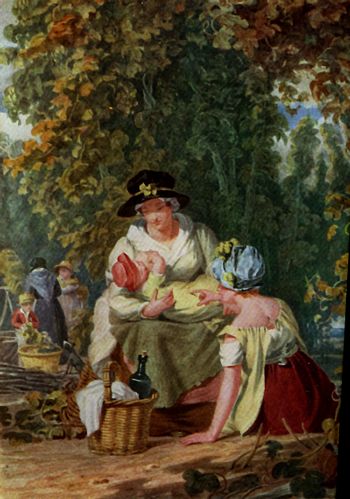
Hop-pickers, W.F. Witherington
- 1792: September 15, 1792 – Hop-women complain of the cold.
- 1791: September 15, 1791 – The springs are very low: the water fails at Webb’s bridge.
- 1789: September 15, 1789 – The hops at Kimbers grow dingy & lose their colour. T.H.W. left us, & went to Fyfield.
- 1788: September 15, 1788 – Gathered many of the baking pears to disburthen the boughs, & keep them from breaking.
- 1787: September 15, 1787 – Women make poor wages in their hop-picking. Housed all my potatoes, & tyed-up many endives.
- 1786: September 15, 1787 – The golden-crowned wren, & the creeper, certhia, seen in my fields.
- 1785: September 15, 1785 – The dripping weather has lasted this day nine weeks, all thro’ haying, & harvest: much hay is also spoiled of the second cutting: so that men, having lost both crops, will in many parts be very short of fodder, especially, as turnips have missed in many places.
- 1784: September 15, 1784 – Mr Randolph left us. The autumn-sown spinage turns-out a fine crop: but it is much too thick. We draw it for use.
- 1781: September 15, 1781 – Thunder & lightening in all quarters round. The spring called Well-head sends forth now, after a severe hot dry summer, & dry spring & winter preceeding, nine gallons of water in a minute; which is 540 in an hour; & 12960, or 216 hogsh. in 24 hours, or one natural day. At this time the wells are very low, & all the ponds in the vales dry.
- 1778: September 15, 1778 – Just at the close of day several teams of ducks fly over the common from the forest: they go probably to the streams about Alresford.
- 1776: September 15, 1776 – Swallows catch at walls as they flie about.
- 1774: September 15, 1774 – Ring-ouzels appear on their autumnal migration. Were seen first last year on the 30th: the year before on the 11th.
- 1772: September 15, 1772 – Papilio Atalanta abounds.
- 1771: September 15, 1771 – Muscae & papiliones abound on on the asters.
- 1768: September 15, 1768 – Black warty water-efts with fin tails & yellow bellies are drawn up in the well-bucket.
Notes:
Seasonal hop-pickers are sufficiently a part of English rural life to feature in a historical pageant. Here is a picture of turn-of-the-20th-century/a>hop-pickers in the Alton area, not far from Selborne.
 Theme Ported to
