Posted by sydney on Sep 14th, 2008
- 1792: September 14, 1792 – From London three gallons of French brandy, & two gallons of Jamaica rum.
- 1791: September 14, 1791 – Hop-picking goes on without the least interruption. Stone-curlews cry late in the evenings. The congregating flocks of hirundines on the church & tower are very beautiful, & amusing! When they fly-off altogether from the Roof, on any alarm, they quite swarm in the air. But they soon settle in heaps, & preening their feathers, & lifting up their wings to admit the sun, seem highly to enjoy the warm situation. Thus they spend the heat of the day, preparing for their emigration, &, as it were consulting when & where they are to go. The flight about the church seems to consist chiefly of house-martins, about 400 in number: but there are other places of rendezvous about the village frequented at the same time. The swallows seem to delight more in holding their assemblies on trees.
“When Autumn scatters his departing gleams,/Warn’d of appraching winter gathered play/The swallow people; & toss’d wide around/O’er the calm sky in convulsion swift,/The feather’d eddy floats: rejoicing once/Ere to their wintry slumbers they retire,/In clusters clung beneath the mouldring bank,/And where, unpierced by frost, the cavern sweats./Or rather to warmer climes convey’d,/With other kindred birds of season, there/They twitter chearful, till the vernal months/Invite them welcome back:– for thronging now/Innumberable wings are in commotion all.”
- 1790: September 14, 1790 – Onions rot. Barley round the village very fine.
- 1788: September 14, 1788 – The gale snapped-off a large bough from my Cadillac pear-tree, which is heavily laden with fruit.
- 1785: September 14, 1785 – Turned the horses into the great meadow: there is a vast after grass, more than when the meadow was mowed in the summer.
- 1784: September 14, 1784 – The heats are so great, & the night so sultry, that we spoil joints of meat, in spite all the care that can be taken.
- 1783: September 14, 1783 – Mr Yalden’s tank is full. Brought down by Brother Thomas White from South Lambeth & planted in my borders: Dog toothed violets. Persian Iris. Quercus cerris. Double ulmaria. Double filipendula. Callis. White fox-glove. Iron fox-glove. Double wall-flower. Double scarlet lychinis.
- 1781: September 14, 1781 – Timothy the tortoise dull & torpid.
- 1777: September 14, 1777 – Black cluster-grapes begin to turn colur. A trenendous & awful earthquake at Manchester, & the district round. The earthquake happened a little before eleven o’ the clock in the forenoon, when many of the inhabitants were gathered in their respective places of worship.
- 1776: September 14, 1776 – Swallows cluster, & hang about in a particular manner at this season of the year. Honey-bees swarm by thousands, & devour the peaches, & nectarines.
- 1775: September 14, 1775 – Little barley housed towards Winton & Andover. Many crops not ripe.
- 1774: September 14, 1774 – Ring-ouzels feed on our haws, & yew-berries in the autumn, & ivy-berries in the spring.
- 1773: September 14, 1773 – Young swallows come out. Barley & oats housed. Some wheat out still.
- 1772: September 14, 1772 – Oats rot as they lie: a very poor scanty crop. Little barley cut, but dead ripe.
- 1771: September 14, 1771 – Great rain in the night. Spring sown wheat still standing. Regulus non cristatus minimus chirps.
- 1770: September 14, 1770 – Several fields of wheat unhoused.
- 1769: September 14, 1769 – Papilio Machaon is found here in May.
Posted by sydney on Sep 13th, 2008
- 1792: September 13, 1792 – The stream at Gracious Street, which fails every dry summer, has run briskly all this year; & now seems to be equal to the current from Well-head. The rocky channel up the hollow-lane towards Rood has also run with water for months: nor has my great water-tub been dry the summer through.
- 1791: September 13, 1791 – My well is very low, & the water foul! Timothy eats voraciously. Winged female ants migrate from their nests, & fill the air. These afford a dainty feast for the hirundines, all save the swifts; they being gone before these emigrations, which never take place till sultry weather in August, & September.
- 1790: September 13, 1790 – Cut 158 cucumbers. Nep. Ben White, & wife, & little Ben & Glyd came from Fyfield.
- 1789: September 13, 1789 – After a bright night, & vast dew, the sky usually becomes clouded by eleven or twelve o’clock in the forenoon; & clear again towards the decline of the day. The reason seems to be, that the dew, drawn-up by evaporation, occasions the clouds, which towards evening, being no longer rendered buoyant by the warmth of the sun, melt away, & fall down again in dews. If clouds are watched of a still, warm evening, they will be seen to melt away, & disappear. Several nests of gold-finches, with fledged young, were found among the vines of the hops: these nestlings must be second broods.
- 1788: September 13, 1788 – Gathered-in my golden pippins, a small quantity. Mr Churton came from Cheshire.
- 1787: September 13, 1787 – Gathered-in my early white pippins.
- 1783: September 13, 1783 – Began to mend the dirty parts of the bostal with chalk.
- 1782: September 13, 1782 – Some few orleans-plums. Ravens about the hill. All the Selborne wheat in, except fome turnip-wheat at the priory.
- 1781: September 13, 1781 – Beans heavy.
- 1779: September 13, 1779 – Gathered-in the filberts, a large crop.
- 1776: September 13, 1776 – My muscle-plums are in much more perfection this year than any other fruit.
- 1775: September 13, 1775 – Good grapes every day, but not delicate. Bag-ed more grapes.
- 1773: September 13, 1773 – Young swallows in nest. Hops very ordinary: very small.
- 1771: September 13, 1771 – Grapes begin to turn colour. Mild.
- 1770: September 13, 1770 – Fly-catcher & white-throat appear.
- 1768: September 13, 1768 – Nectarines rot on ye trees. Ravens are continually playing by pairs in the air.
Posted by sydney on Sep 12th, 2008
- 1792: September 12, 1792 – Began to light fires in the parlor. J.W. left us.
- 1789: September 12, 1789 – Some wheat is out. Trimming has a large field not cut. Gentiana Amarella, autumnal gentian, or fell-wort, buds for bloom on the hill. Sent 12 plants of Ophrys spiralis to Mr Curtis of Lambeth marsh.
- 1787: September 12, 1787 – Lapwings leave the low grounds, & come to the uplands in flocks. A pair of honey-buzzards, & a pair of wind-hovers appear to have young in the hanger. The honey-buzzard is a fine hawk, & skims about in a majestic manner.
- 1785: September 12, 1785 – Wasps much subdued.
- 1783: September 12, 1783 – Tyed-up endives: they are backward this year, & not well-grown. One sowing never came up. The barley about Salisbury lies in a sad wet condition.
- 1780: September 12, 1780 – Timothy still feeds a little. Ophrys spiralis, Ladies-traces, blows pentifully in the long lithe, & on the common near the beechen-grove.
- 1776: September 12, 1776 – The wasps, tho’ by no means numberous, plunder the hives, & kill the bees, which are weak & feeble, this wet autumn: “asper crabro imparibus se emiscuit armis.”
- 1775: September 12, 1775 – Put 50 fine bunches of grapes in crape bags to secure them from wasps.
- 1774: September 12, 1774 – Great hail at Winton. Wasps abound in woody, wild districts far from neighbourhoods: how are they supported there without orchards, or butcher’s shambles, or grocer’s shops? * Wasps nesting far from neighbourhoods feed on flowers, & catch flies & caterpillars to carry to their young. Wasps make their nests with the raspings of sound timber, hornets with what they gnaw from decayed. These particles of wood are neaded up with a mixture of saliva from their bodies, & moulded into combs.
- 1768: September 12, 1768 – Sheep die frequently on the common, tho’ so wholesome a spot. Ravens flock on the hanger.
Posted by sydney on Sep 11th, 2008
- 1791: September 11, 1791 – Grey crow returns, & is seen near Andover. Some nightly thief stole a dozen of my finest nectarines.
- 1789: September 11, 1789 – Ophrys spiralis, ladies traces, in bloom the long Lythe, & on top of the short Lythe. Wasps seize on butter-flies, &, shearing off their wings, carry their bodies home as food for their young: they prey much on flies.
- 1788: September 11, 1788 – Nep. Ben & Wife, & nurse & baby left us, & went to Newton.
- 1787: September 11, 1787 – Cow-grass housed. Gathered heaps of Cucumbers.
- 1783: September 11, 1783 – Sam White, & Ben Woods returned to Fyfield. Fly-catcher. Harvest moon. Selborne hopping lasts only two days in Farmer Spencer’s, & Master Hale’s gardens; many gardens afford no pickings at all. Mr Hale will have only about 200 weight. The great garden at Hartley, late Sr. Sim. Stuart’s, consisting of 20 acres, produced only about 2 tons.
- 1782: September 11, 1782 – Goody Hammond returned to weed in the garden. Got-in two loads of wheat at last in good order. The perfoliated yellow centaury in seed on the bank above Tull’s cottage. Chlora perfoliata. On this day Lord Howe sailed from Spithead with 34 ships of the line, as is supposed for the relief of Gibraltar.
- 1781: September 11, 1781 – Bean-harvest & vetch harvest.
- 1779: September 11, 1779 – The rain that fell in my absence was 73.
- 1778: September 11, 1778 – Martins congregate in vast flocks, & frequent trees, & seem to roost in them. The second brood of Martins near the stair-case window, which were hatched Aug. 8, came-out September 5th. So that the building a nest, & rearing two broods take up much about four months, May, June, July, & August; during September they congregate, & retire in October.
- 1777: September 11, 1777 – Mrs Snooke’s tortoise devours kidney-beans & cucumbers in a most voracious manner: swallows it’s food almost whole. * Timothy the tortoise weighed six pounds 3 quarters, 2 oz. & a half: so he is not at all encreased in weight since this time last year. The scales were not very exact.
- 1775: September 11, 1775 – Much barley abroad, most of it standing: what is cut lies in a sad way. Hop-picking becomes interrupted: hops become brown.
- 1774: September 11, 1774 – Martins do not seem to engage much this year in second broods. Are they discouraged by the cold, wet, season?
- 1773: September 11, 1773 – Wasps encrease, & injure peaches & nect: & begin on the grapes. Young martins come out.
- 1772: September 11, 1772 – Ring-ouzel appears on it’s autumnal visit: several seen. Stoparolas seem to be gone for three days past.
Posted by sydney on Sep 10th, 2008
- 1791: September 10, 1791 – Young broods of swallows come out. Cut 171 cucumbers; in all 424 this week. Sweet moon light!
- 1790: September 10, 1790 – Cut 140 cucumbers. Hops light, & not very good. Sister Barker & Molly & Betsy left us, & went to London: Charles White also, & Bessy returned to Fyfield.
- 1785: September 10, 1785 – Boys bring the 26th wasp’s nest. Mens second crop of clover cut, & spoiled by the rains. A bad prospect with respect to winter fodder! Farmer Spencer sows some wheat-stubbles with rye for spring feed.
- 1784: September 10, 1784 – Uncrested wrens seem to be withdrawn. Mr Richardson’s wall fruit at Bramshot-place is not good-flavoured, nor well-ripened & his vines are so injured by the cold, black summer, as not to be able to produce any fruit, or good wood for next year. Mr Dennis’s vines at Bramshot also are in poor state.
- 1783: September 10, 1783 – Gathered-in the white pippins, a great crop. Cleansed-out the zig-zag. Tho. Holt White, & Henry Holt White came. Bessy White, Sam White, & Ben Woods came from Fyfield. The Virginian Creeper is grown up to the eaves; but will probably shoot no farther, as the leaves at bottom begin to turn red. Total eclipse of the moon.
- 1781: September 10, 1781 – Red-breasts feed on elder-berries, enter rooms, & spoil the furniture. Bror. T. & M. came to Selborne. Timothy, whose appetite is now on the decline, weighs only 7 pounds & 3/4 of an ounce: at Midsummer he wighed 7 ae 1 oun.
- 1780: September 10, 1780 – The motions of Timothy the tortoise are much circumscribed: he has taken to the border under the fruit-wall, & makes very short excursions: he sleeps under a Marvel of Peru. Lapwings frequent the upland fallows.
- 1779: September 10, 1779 – Gloomy, still, sultry, soft showers.
- 1774: September 10, 1774 – Oats housed all day. Swifts retire usually between the 10th & the 20th of Aug: flycatchers, stoparolae, which are the latest summer birds of passage, not appearing ’til the 20 of May, withdraw about the 6th of September.
- 1773: September 10, 1773 – Sad harvest & hop-picking weather! Rain damages the wall-fruit.
- 1772: September 10, 1772 – Swallows & martins congregate in vast clouds.
- 1771: September 10, 1771 – Spring sown wheat is cut. Hirundines swarm under the hanger.
- 1770: September 10, 1770 – The hop-picking at Farnham is just beginning. About 8,000 people beside natives are employed. A vast crop. Much wall fruit at Farnham castle; but void of flower.
- 1769: September 10, 1769 – Land rail.
- 1768: September 10, 1768 – Hedge-hogs bore holes in the grass-walks to come at the plantain roots, which they eat upwards.
Posted by sydney on Sep 9th, 2008
- 1792: September 9, 1792 – As most of the second brood of Hirundines are now out, the young on fine days congregate in considerable numbers on the church & tower: & it is remarkable that tho’ the generality is on the battlements & roof, yet many hang or cling for some time by their claws against the surface of the walls in a manner not practiced at any other time of their remaining with us. By far the greater number of these amusing birds are house-martins, not swallows, which congregate on trees. A writer in the Gent. Mag. supposes that the chilly mornings & evenings, at the decline of the year, begin to influence the feelings of the young broods; & that they cluster thus in the hot sunshine to prevent their blood from being benumbed, & themselves from being reduced to a state of untimely torpidity.
- 1791: September 9, 1791 – Gathered in the white apples, a very fine crop of large fine fruit, consisting of many bushels.
- 1790: September 9, 1790 – Two stone-curlews in a fallow near Southington. A fern-owl flies over my house.
- 1789: September 9, 1789 – Hops are not large. The fly-catchers, which abounded in my outlet, seem to have withdrawn themselves. Some grapes begin turn colour. Men bind wheat. Sweet harvest, & hop-picking weather. Hirundines congregate on barns, & trees, & on the tower. The hops are smaller than they were last year. There is fine clover in many fields.
- 1788: September 9, 1788 – On the brow of the cliff that looks down on Candover’s farm-house my Brother found a lime-tree which had been cut down to a stool, when the coppice was cut formerly. Was it a wild tree or planted?
- 1783: September 9, 1783 – Mr. Etty’s well is still foul. Began to light fires in the parlor. Brother Thomas, & Molly White came.
- 1781: September 9, 1781 – Red-breasts whistle agreeably on the tops of hop-poles, &c., but are prognostic of autumn. Young fern-owl.
- 1780: September 9, 1780 – My kindey-beans are much withered for want of rain: cucumbers bear: peaches begin to come: endives large, & tyed-up. Gathered-in the Burgamot-pears; they easily part from their stems. Hop-picking partly ended. Myriads of flying ants, of the small pale, yellow sort, fly from their nests & fill the air.
- 1779: September 9, 1779 – The greens of the turneps in light shallow land are quite withered away for want of moisture.
- 1775: September 9, 1775 – Wasps somewhat abated. The day & night insects occupy the annuals alternatelly: the papilios, muscae, & apes are succeeded at the close of the day by phalanae, earwigs, woodlice, etc. My tallest beech measures in girth at least three feet from the ground six feet & four inches. It grows at the S.E. end of Sparrow’s hanger, & appears to be upwards of 70 feet high.
- 1774: September 9, 1774 – Mushrooms. Hops distempered.
- 1773: September 9, 1773 – Little barley housed.
- 1771: September 9, 1771 – Missel-thrushes flock.
Posted by sydney on Sep 8th, 2008
- 1792: September 8, 1792 – Sowed thirteen rods, on the twelfth part of an acre of grass ground in my own upper Ewel close with 50 pounds weight of Gypsom; also thirteen rods in Do. with 50 pounds weight of lime; thirteen rods more in Do. with 50 pounds weight of wood & peat-ashes: and four rods more on Do. with peat-dust. All these sorts of manures were sown by Bror T. W. on very indifferent grass in the way of experiment.
- 1789: September 8, 1789 – Bror T. W. & Th. H. W. came from London.
- 1787: September 8, 1787 – Mrs Brown brought to bed of a boy, who added to 49 before, encreased my nephews & nieces to the round number of 50.
- 1786: September 8, 1786 – Made a pint of catsup. Heavy rain.
- 1785: September 8, 1785 – Mr S. Barker came. Planted a Parnassia, which he brought out of Rutland in full bloom, in a bog at the bottom of Sparrow’s hanger.
- 1783: September 8, 1783 – Ponds are filled. Hirundines skulk about to avoid the cold wind. Mr Sam. Barker left us, & went to Fyfield.
- 1782: September 8, 1782 – People complain of harvest-bugs. Thermr in the sun 110. On this day Mrs Brown, of Uppingham in the County of Rutland, eldest daugher of my Sister Barker, was brought to bed of a daugher, her third child. My nephews & nieces living are now 17 nephews: 15 nieces: 2 grand nephews: 2 grand nieces: 2 nephews by marriage: total 38. One Niece since, 39. 8 nephews & nieces dead.
- 1780: September 8, 1780 – Barley-harvest on the downs.
- 1776: September 8, 1776 – A sharp, single, crack of thunder at Faringdon: the air was cold, & chilly.
- 1775: September 8, 1775 – Wasps abound, & mangle the graps: we have, I should think, destroyed 50000.
- 1774: September 8, 1774 – Wheat housing. Whitethroats still seen.
- 1771: September 8, 1771 – Blowing and winter-like.
Posted by sydney on Sep 7th, 2008
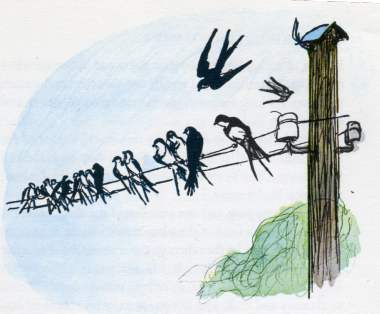
Swallows congregating, E.H. Shepard, from “The Wind in the Willows”
- 1791: September 7, 1791 – Cut 125 cucumbers. Young martins, several hundreds, congregate on the tower, church, & yew-tree. Hence I conclude that most of the second broods are flown. Such an assemblage is very beautiful, & amusing, did it not bring with it the association of ideas tending to make us reflect that winter is approaching; & that these little birds are consulting how they may avoid it.
- 1789: September 7, 1789 – Mr Thomas Mulso left us & went to Winton.
- 1782: September 7, 1782 – Many Selborne farmers finished wheat-harvest. The latter housings are in delicate order: the early housed will be cold, & damp. The swifts left Lyndon in the county of Rutland, for the most part, about August 23. Some continued ’till August 29: & one till September 3!! In all our observation Mr Barker & I never saw or heard of a swift in September, tho’ we have remarked them for more than 40 years. All nature this summer seems to keep pace with the backwardness of the season.
- 1781: September 7, 1781 – Dines at Bramshot-place.
- 1779: September 7, 1779 – No mushrooms for want of more moisture.
- 1777: September 7, 1777 – Swallows & house-martins dip much in ponds. Vast Northern Aurora.
- 1775: September 7, 1775 – In the dusk of the evening when beetles begin to buz, partridges begin to call; these two circumstances are exactly coincident.
- 1774: September 7, 1774 – Hops brown & small, & not esteemed very good. Wheat out still.
- 1773: September 7, 1773 – People begin to pick hops.
- 1772: September 7, 1772 – Peaches begin to ripen.
- 1768: September 7, 1768 – First blanched endive. Some wheat standing still. A few wasps. Inyx still appears.
In the osiers which fringed the bank he spied a swallow sitting. Presently it was joined by another, and then by a third; and the birds, fidgeting restlessly on their bough, talked together earnestly and low.
`What, already,’ said the Rat, strolling up to them. `What’s the hurry? I call it simply ridiculous.’
`O, we’re not off yet, if that’s what you mean,’ replied the first swallow. `We’re only making plans and arranging things. Talking it over, you know — what route we’re taking this year, and where we’ll stop, and so on. That’s half the fun!’
“The Wind in the Willows”, Kenneth Grahame, 1908
Posted by sydney on Sep 5th, 2008
- 1791: September 5, 1791 – Cut 107 cucumbers. Nectarines are finely flavoured, but eaten by bees, & wasps. Churn-owl is seen over the village: fly-catchers seem to be gone.
- 1790: September 5, 1790 – Boiled a mess of autumnal spinage, sown Aug. 3rs. Nep J. White left us, & returned to Sarum. There is a fine thriving oak near the path as you go to Combwood, just before you arrive at the pond, round which, at about the distance of the extremities of the boughs, may be seen a sort of circle in the grass, in which the herbage appears dry & withered, as if a fariy-ring was beginning. I remember somewhat of the same appearance at the same place in former years.
- 1787: September 5, 1787 – Stone-curlews pass over followed by their young, which make a piping, wailing noise.
- 1782: September 5, 1782 – The air is full of flying ants, & the hirundines fare luxuriously.
- 1777: September 5, 1777 – Sultry & gloomy. Wasps abound.
- 1776: September 5, 1776 – Some wasps on the wall-fruit. Where wasps gnaw a hole, the honey-bees come & suck the pulp. Al fruits are backward, watry, & bad.
- 1775: September 5, 1775 – Grey, spitting, bright & sultry, distant lightening. Wasps swarm.
- 1774: September 5, 1774 – Most people in Selborne begin picking their hops. Wheat housed all day.
- 1772: September 5, 1772 – Rain. Oats grow as they lie. Some wheat abroad. Bad for hop-picking. A strange yellow tint in the sky at sunset. Distant thunder & lightening in the evening.
- 1771: September 5, 1771 – Dark. Sun. Wheat pretty well cut-down. Soft & still.
Posted by sydney on Sep 4th, 2008
- 1792: September 4, 1792 – Hop-picking becomes general; & the women leave their gleaning in the wheat-stubbles. Wheat grows as it stands in the shocks.
- 1789: September 4, 1789 – Mr Thomas Mulso comes from London. Wry-necks, birds so called, appear on the grass-plots and walks: they walk a little as well as hop, & thrust their bills into the turf, in quest, I conclude, of ants, which are their food. While they hold their bills in the grass, they draw out their prey with their tongues, which are so long as to be coiled round their heads.
- 1788: September 4, 1788 – Vast showers about. Were all wet thro’ in our return from Faringdon. Under the eaves of an house at Faringdon are 22 martin’s nests, 12 of which contain second broods now nearly fledge: they put out their heads, & seem to long to be on the wing.
- 1787: September 4, 1787 – Vast numbers of partidges. A young fern-owl shot at Newton.
- 1786: September 4, 1786 – Cut my new rick; the hay is good.
- 1785: September 4, 1785 – Boys bring the 25th wasp’s nest.
- 1784: September 4, 1784 – My Nep. Edmund White launched a balloon on our down, made of a soft, thin paper; & measuring about two feet & a half in length, & 20 inches in diameter. The buoyant air was supplyed at bottom by a plug of wooll, wetted with spirits ofwine, & set on fire by a candle. The air being cold & moist this machine did not succeed well abroad; but in Mr Yalden’s stair-case it rose to the ceiling, & remained suspended as long as the spirits continued to flame, & then sunk gradually. These Gent. made the balloon themselves. This small exhibition explained the whole balloon affair very well: but the position of the flame wanted better regulation; because the least oscillation set the paper on fire. Golden weather, red even.
- 1783: September 4, 1783 – Tremella nostoc appears on the walks. Tho’ the weather may have been ever so dry & burning, yet after two or three wet days this strange jelly-like substance abounds.
- 1782: September 4, 1782 – Began to cut the first endive: finely blanched. Curlews clamour.
- 1781: September 4, 1781 – Gathered one bunch of black grapes, which was ripe & well-flavoured. It grew close to the wall, pressed down by a bough.
- 1780: September 4, 1780 – The trufle-man came & hunted my brother’s grove for the first time: but found only half a pound of trufles, & those shrivelled & decayed, for want of moisture.
- 1778: September 4, 1778 – Ladies-traces blow, & abound in the long Lithe. A rare plant. * The young house-martins of the first flight are often very troublesome by attemtping to get into the nest among the second callow broods; while their dams are as earnest to keep them out, & drive them away.
- 1775: September 4, 1775 – Linnets congregate. Wasps swarm about the Grapes, tho’ so many nests have been destroyed.
- 1774: September 4, 1774 – Wood-owls hoot much.
- 1772: September 4, 1772 – Spring corn in a bad way where cut. Barley in general not ripe. Hot & moist. Grass grows.
- 1771: September 4, 1771 – Hop-picking begins. Hops small. Much wheat not ripe yet.
- 1770: September 4, 1770 – The ring-ousel appears again in it’s autumnal visit; but about twenty days earlier than usual.
- 1769: September 4, 1769 – Hop-picking begins. A very slender crop.
 Theme Ported to