Posted by sydney on Aug 14th, 2008
- 1792: August 14, 1792 – Housed two loads of peat.
- 1791: August 14, 1791 – Hirundines enjoy the warm season. Late this evening a storm of thunder arose in the S., which, as usual, divided into two parts, one going to the S.W. & W. & the greater portion to the S.E. and E., & so round to the N.E. From this latter division proceeded strong, & vivid lightening till late in the night. At Headleigh there was a very heavy shower, & some hail at E. Tisted. The lightening, & hail did much damage about the kingdom. Farmer Spencer’s char-coal making in his orchard almost suffocated us: the poisonous smoke penetrated into our parlor, & bed-chambers, & was very offensive in the night.
- 1790: August 14, 1790 – Young Hirundines cluster on the trees. Harvest-bugs bite the ladies.
- 1788: August 14, 1788 – H.W. & Miss W. left us & went to Newton. Bro. Henry, & B. White, & wife came with little Tom, & Nurse Johnson.
- 1787: August 14, 1787 – Gleaning begins.
- 1784: August 14, 1784 – Plums show no tendency to ripeness. Scalded codlings come in. The wheat that was smitten by the hail does not come to maturity together: some ears are full ripe, & some quite green. Wheat within the verge of the hail-storm is much injured, & the pease are spoiled. A puff-ball, lycoperdon bovista, was gathered in a meadow near Alton, which weighed 7 pounds, & an half, & measured 1 Yard and One Inch in girth the longest way 3 feet two inches. There were more in the mead almost as bulky as this.
- 1782: August 14, 1782 – The lavant runs by the side of Cobb’s court-yard. Swifts about High-Wycombe.
- 1781: August 14, 1781 – The bank-martins at the sand-pit on Short-heath are now busy about their second brood, & have thrown out their egg-shells from their holes. The dams & first-broods make a large flight. When we approached their caverns, they seemed anxious, & uttered a little wailing note. My well is low in water; but a constant spring bubbles up from the bottom. Some neighbouring wells are dry. My well is 63 feet deep.
- 1780: August 14, 1780 – Sope-wort blows. Dwarf elder continues in bloom.
- 1775: August 14, 1775 – Two great bats appear. They feed high: are very rare in Hants, & Sussex. Low fog.
- 1773: August 14, 1773 – Wheat-harvest pretty general. Dark heavy clouds to the N.W. Heat unusually severe all this week! This storm did great damage in & about London.
- 1772: August 14, 1772 – Cloudless, sultry, dark.
- 1770: August 14, 1770 – Pease begin to be hacked. Saw two swifts.
Posted by sydney on Aug 13th, 2008
- 1792: August 13, 1792 – Goose-berries wither on the trees.
- 1791: August 13, 1791 – Farmer Tull makes a wheat-rick at Wick-hill.
- 1787: August 13, 1787 – Mr & Mrs Richardson & son came.
- 1785: August 13, 1785 – My Nephew Edmd White’s tank at Newton runs over. On the first of August, about half an hour after three in the afternoon the people of Selborne were surpried by a shower of Aphides which fell in these parts. I was not at home; but those who were walking the streets at that juncture found themselves covered with these insects, which settled also on the trees, & gardens, & blackened all the vegetables where they alighted. My annuals were covered with them; & some onions were quite coated over with them when I returned on Aug. 6th. These armies, no doubt, were then an a state of emigration, & shifting their quarters; & might come, as far as we know, from the great hop-plantations of Kent or Sussex, the wind being that day at E. They were observed at the same time at Farnham, & all along the vale to Alton. Of the conveyance of Insects from place to place, see Derhams’s Physico-Theology. p. 367.
- 1783: August 13, 1783 – Farmer Spencer of Grange finished wheat-harvest. Mr Pink of Faringdon finished Do. Mr Yalden finished wheat-harvest. Fermer Vridger of Black-more finished harvest of all sorts.
- 1782: August 13, 1782 – Bro. Tho. White & daughter came.
- 1781: August 13, 1781 – The pond on Selborne down has still some good water in it; Newton pond is all mud. Many annuals are shrivelled-up for want of moisture. The drought is very great. Hops are injured for want of rain.
- 1780: August 13, 1780 – Ponds are very low.
- 1778: August 13, 1778 – There is this year the greatest crop of wheat in the North-field that ever was remembered.
- 1773: August 13, 1773 – Great thunder, & lightening.
- 1772: August 13, 1772 – Some few wasps begin to appear.
- 1770: August 13, 1770 – Swifts to be partly gone. Martins congregate.
- 1768: August 13, 1768 – Sweet harvest weather. Helleborus viridis begins to wither. Brisk gale of wind.
Posted by sydney on Aug 12th, 2008
- 1792: August 12, 1792 – The thermometer for three or four days past has stood in the shade at Newton at 79, & 80.
- 1791: August 12, 1791 – Men bind their wheat all day. The harvesters complain of heat. The hand-glass cucumbers begin to bear well: red kidney beans begin to pod.
- 1790: August 12, 1790 – Sister Barker, & nieces, Mary, & Eliz. came.
- 1789: August 12, 1789 – The planters think these foggy mornings, & sunny days, injurious to their hops.
- 1787: August 12, 1787 – Bull-finches feed on the berries of honey-suckles. B. Hall came.
- 1785: August 12, 1785 – Black-caps eat the berries of the honey-suckle, now ripe. Pheasant-cocks crow.
- 1784: August 12, 1784 – Wheat housing at Heards.
- 1782: August 12, 1782 – Swifts about Windsor.
- 1780: August 12, 1780 – Dust flies. Gardens suffer from want of rain. Much wheat bound. Timothy, in the beginning of May, after fasting all the winter, weighed only six pounds & four ounces averdupoise; is now encreased to six pounds & 15 ounces, averdupoise.
- 1778: August 12, 1778 – My well sinks very much.
- 1775: August 12, 1775 – Full moon. High tides frequently discompose the weather in places so near the coast, even in the dryest, most settled season, for a day or two.
*Cimices lineares are now in high copulation on ponds & pools. The females, who vastly exceed the males in bulk, dart & shoot along the surface of the water with the males on their backs. When a female chuses to be disenegaged, she rears & jumps & plunges like an unruly colt; the lover, thus dismounted, soon finds a new mate. The females as fast as their curiosities are satisfied retire to another part of the lake, perhaps to deposit their foetus in quiet: hence the sexes are found separate except where generation is going-on. From the multitude of minute young of all gradations of size, thses insects seem without doubt to be viviparous.
- 1774: August 12, 1774 – Fly-catchers bring out young broods. Mich. daisy blows. Apricots ripen. Some martins, dispossessed of their nests by sparrows, return to them again when their enemies are shot, & breed in them. Several pairs of martins have not yet brought forth their first brood. They meet with interruptions, & leave their nests.
- 1770: August 12, 1770 – Lapwings flie in parties to the downs as it grows dusk.
Posted by sydney on Aug 11th, 2008
- 1791: August 11, 1791 – Half hogshead of portwine from Southhamton. Gleaners come home with corn.
- 1789: August 11, 1789 – Got-in forest-fuel in nice order. Farmer Knight begins wheat harvest. Lovely weather.
- 1787: August 11, 1787 – The children in strawberry time found & destroyed several pheasant’s nests in Goleigh wood. Nep. and Niece Ben White came from London.
- 1782: August 11, 1782 – Five swifts at E. Tisted.
- 1781: August 11, 1781 – Ponds & streams fail. People in many parts in great want of water. The reapers were never interrupted by rain one hour the harvest thro’.
- 1780: August 11, 1780 – The Papilio Machaon never appeared but once in my garden.
- 1774: August 11, 1774 – One of my vines looks pale & sickly. Ivy budds for bloom: it blows in Octr & Novr. and the fruit ripens in April.
- 1772: August 11, 1772 – Wheat-harvest becomes pretty general. Barom. sinks & rises to it’s former pitch.
- 1771: August 11, 1771 – Heavy clouds round the horizon. Lambs play, & frolick.
- 1768: August 11, 1768 – Wheat harvest is pretty general. The male and female flying ants, leaving their nests, fill the air. See Gould on ants.
Posted by sydney on Aug 10th, 2008
- 1790: August 10, 1790 – A labourer has mown out in the precincts of Hartley-wood, during the course of this summer, as many pheasant’s nests as contained 60 eggs! Bro. Thomas White came.
- 1789: August 10, 1789 – Monotropa Hypopithys abounds in the hanger beyond Maiden dance, opposite to coney-croft hanger.
- 1787: August 10, 1787 – When the redbreasts have finished the currans, they begin with the berries of the honey-suckles, of which they are very fond.
- 1785: August 10, 1785 – Men bind their wheat as fast as they reap it. Hops look black.
- 1784: August 10, 1784 – Mr & Mrs Mulso, &c., left us.
- 1780: August 10, 1780 – Sowed a crop of spinage for the winter, and spring, & trod the seed well in.
- 1779: August 10, 1779 – Wheat lies in a bad way. Peaches, & plums rot. Wheat grows. Flying ants swarm in millions. Inches of rain 3.
- 1776: August 10, 1776 – Hay not housed at Meonstoke & Warnford.
- 1774: August 10, 1774 – No swifts: are seen no more with us.
- 1773: August 10, 1773 – Most sultry night.
- 1772: August 10, 1772 – An autumnal coolness begins to take place, morning and evening.
- 1771: August 10, 1771 – Flying ants, male & female.
- 1769: August 10, 1769 – Mr Sheffield of Worcester Coll. went in to Wolmer-forest & procured me a green sand-piper, Tringa Aldrov; Tringa ochropus Lin. They were in pairs & had been seen about by many people on the streams, & banks of the ponds.
- 1768: August 10, 1768 – Young pheasants are flyers. White butter-flies gather in flocks on the mud of puddles.
Posted by sydney on Aug 9th, 2008
- 1789: August 9, 1789 – The country people have a notion that the Fern-owl or Churn-owl, or Eve-jarr, which they also call a Puckeridge, is very injurious to weanling calves by inflicting, as it strikes at them, the fatal distemper known to cow-leeches as Puckeridge. Thus does this harmless, ill-fated bird fall under a double imputation, which it by no means deserves; in Italy, of sucking the teats of goats, whence it is called Caprimulgus; & with us, of communicating a deadly disorder to cattle. But the truth of the matter is, the malady above-mentioned is occasioned by the Oestrus bovis, a dipterous insect, which lays it’s eggs along the backs (chines) of kine, where the maggots, when hatched, eat their way thro’ the hide of the beast into the flesh, & grow to a very large size. I have just talked with a man, who says he has, more than once stripped calves who have died of the puckeridge; that the ail, or complaint lay along the chine, where the flesh was much swelled, & filled with purulent matter. Once myself I saw a large rough maggot of this sort taken (squeezed) out of the back of a cow. These maggots in Essex are called wornils. The least observation & attention would convince men, that these birds neither injure the goatherd, nor the grazier, but are perfectly harmless, & subsist alone, being night birds, on night-insects, such as scarabaei & phalaneae; thro’ the month of July mostly on the scarabaeus solstitialis, which in many districts abounds at that season. Those that we have opened, have always had their craws stuffed with large night-moths & their eggs, & pieces of chafers: nor does it anywise appear how they can, weak & unarmed as they are, inflict any harm upon kine, unless they possess the powers of animal magnetism, & can affect them by fluttering over them. Mr Churton informs me “that the disease along the chine of calves, or rather the maggots that cause them, are called by the graziers in Cheshire worry brees, & a single one worry-bree.” No doubt them mean a breese, or breeze, one name for the gad-fly or Oestrus, which is the parent of these maggots, & lays it’s eggs on the backs of kine. Dogs come into my garden at night, & eat my goose-berries. Levant weather.
- 1788: August 9, 1788 – Wheat harvest will mostly be finished by Monday; viz. in old July.
- 1785: August 9, 1785 – Mushrooms come in. Fire gleams. Fly-catchers, second brood, forsake their nest.
- 1783: August 9, 1783 – Flies come in a door, & swarm in the windows; especially that species called Conops calcitrans. Nep. John White came by the coach from London.
- 1782: August 9, 1782 – Hops are injured by the late winds. Swifts about Reading
- 1781: August 9, 1781 – One swift, perhaps a pair, going in & out of the eaves of the church. Why do these linger behind the rest, which have withdrawn some days? have they a backward brood delayed by some accident?
- 1774: August 9, 1774 – Young martins abound. Wheat-harvest begins with us. The swifts appear again.
- 1769: August 9, 1769 – Wheat begins to be cut at Selborne. Swifts appear to be gone. Swallows congregate in trees with their young & whistle much. Young martins begin to congregate on ye wallnut trees. Nuthatch chirps much. One swift appears. Caprimulgus chatters.
Posted by sydney on Aug 8th, 2008
- 1792: August 8, 1792 – My lower wall nut-tree casts it’s leaves in a very unusual manner. No wall-nuts; the crop dropped off early in the summer.
- 1791: August 8, 1791 – Some young broods of fly-catchers fly about.
- 1789: August 8, 1789 – Two poor, half-fledged fern-owls were brought me: they were found out in the forest among the heath. Farmer Hewet of Temple cut 30 acres of wheat this week. This wheat was lodged before it came into ear, & was much blighted. It grew on low grounds: the wheat on the high malms at Temple is not ripe.
- 1785: August 8, 1785 – Pease lie in a sad state, & shatter-out. Gleaning begins: wheat is heavy. Agaricus pratensis champignion, comes-up in the fairey-ring on my grass-plot.
- 1781: August 8, 1781 – We have shot 31 black-birds, and saved our gooseberries.
- 1778: August 8, 1778 – Full moon. The pair of martins which build by the stair-case window, where their first brood came-out on July 7: are now hatching a second brood, as appears by some egg-shells thrown-out.
- 1777: August 8, 1777 – Flocks of lap-wings migrate to the downs & uplands.
- 1775: August 8, 1775 – Broods of flycatchers come out.
- 1773: August 8, 1773 – Hops have been some time in bloom, & do not promise for much of a crop: they are lousy and do not run up the poles well.
- 1772: August 8, 1772 – Fog, sun, & brisk wind, serene. Ripening weather. Young martins (the first brood) congregate and are very numerous; the old ones breed again.
- 1771: August 8, 1771 – Rain in the night, with wind. Swifts. Sultry & moist: cucumbers bear abundantly. Showers about. Procured a second large bat, a male.
Posted by sydney on Aug 7th, 2008

Title page to Robert Boyle’sThe Sceptical Chymist, concerning itself with pneumatics, or the laws whereby air is condensed, & rarifyed.
- 1792: August 7, 1792 – Several of my neighbours went up the Hill (this being the day of the great review at Bagshot heath) whence they heard distinctly the discharges from the ordnance, & small arms, & saw the clouds of smoke from the guns. The wind being N.E. they smelled, or seemed to smell, the scent of the gunpowder. Wickham bushes, the scene of action, is more than 20 miles from hence. The crouds of people assembled upon this occasion were great beyond anything seen at such meetings!
- 1791: August 7, 1791 – Received from Farnham, well packed in a box, a picture of a mule pheasant, painted by Mr Elmer, & given me by Lord Stawell. I have fixed it in a gilt, burnished frame, & hung it in my great parlor, where it makes an elegant piece of furniture. The first broods of swallows, & house-martins, which congregate on roofs, & trees, are very numerous, & yet I have not this year one nest about my buildings.
- 1790: August 7, 1790 – Strawberries from the woods are over; the crop has been prodigious. The decanter, into which wine from the cool cellar was poured, became clouded over with a thick condensation standing in drops. This appearance, which is never to be seen but in warm weather, is a curious phaenomenon, & exhibits matter for speculation to the modern philosopher. A friend of mine enquires whether the “rorantia pocula” of Tully in his “de senectute” had any reference to such appearances. But there is great reason to suppose that the ancients were not accurate philosophers enough to pay much regard to such occurrences. They knew little of pneumatics, or the laws whereby air is condensed, & rarifyed; & much less that water is dissolved in air, & reducible therefrom by cold. If they saw such dews on their statues, or metal utensiles, they looked on them as ominous, & were awed with a superstitious horror. Thus Virgil makes his weeping statues, & sweating brazen vessles prognostic of the violent death of Julius Caesar:.. “maestrum illacrymat templis ebur, aeraq sudant.” Georgic 1st
- 1789: August 7, 1789 – Mr & Mrs Barker, & Miss Eliz. Barker rode to Blackdown to see the prospect, & returned by 3 o’clock: they set out at six in the morning.
- 1788: August 7, 1788 – Two or three beeches below Bradshot are quite loaded with mast. The King’s field is cleared, & thrown open.
- 1785: August 7, 1785 – Sarah Dewey came to assist in the family.
- 1784: August 7, 1784 – Many hop-poles are blown down. Cool, autumnal feel. Days much shortened.
- 1782: August 7, 1782 – Vast rains in the night. The quantity of rain since Jan. 1st 1782, is 36 in. 1 h.!!!
- 1779: August 7, 1779 – Rain, rain, rain. Wheat under the hedges begins to grow.
- 1777: August 7, 1777 – Finished the chimney of my parlor: it measures 30 feet from the hearth to the top.
- 1775: August 7, 1775 – Timothy, Mrs Snookes’ old tortoise has been kept full 30 years in her court before the house, wieghs six pounds three quarters, & one ounce. It was never weighed before, but seems to be much grown since it came.
- 1774: August 7, 1774 – Much wheat blighted. Swifts have not appear’d for these two evenings.
- 1773: August 7, 1773 – The flight of the scarabaeus solstitiales seems to be over. Measles still in some families.
- 1771: August 7, 1771 – Rye-harvest begins. Procured the above-mentioned specimen of the bat, a male.
- 1770: August 7, 1770 – Those maggots that make worm-holes in tables, chairs, bed-posts, &c., & destroy wooden-furniture, especially where there is any sap, are the larvae of the ptinus pectinicornis. This insect, it is probable, deposits its eggs on the surface, & the worms eat their way in. In their holes they turn into the pupa state, & so come foth winged in July: eating their way thro’ the valences or curtains of a bed, or any other furniture that happens to obstruct their pasasge. They seem to be most inclined to breed in beech; hence beech will not make lasting utensils, or furniture. If their eggs are deposited on the surface, frequent rubbings will preserve wooden furniture.
- 1769: August 7, 1769 – Showers to the S. Wheat, rye, oats, barley cutting round the forest.
- 1768: August 7, 1768 – Cold dew. Mulberry begins to cast some leaves. Tops of beeches in the hanger begin to look pale.
Posted by sydney on Aug 6th, 2008

Cotinus coggygria, the smoke tree, in White’s time went by the Linnean name Rhus Cotinus.
- 1791: August 6, 1791 – Boys bring wasp’s nest. Codlings, & stewed cucumber come in. Housed, & piled 8 cords of beechen billet in fine order. Watered the cucumbers; well very low.
- 1790: August 6, 1790 – The fern-owl churs still; grass-hopper lark has been silent some days.
- 1789: August 6, 1789 – Rhus Cotinus, sive Coccygria blows; it’s blossom is very minute, & stands on the extremities of it’s filiform bracteols, which have sort of feather-like appearance that gives the shrub a singular, & beautiful grace. This tree does not ripen it’s berries with us. Is a native of Lombardy, & to be found at the foot of the Apennine, & in Carniola.
- 1788: August 6, 1788 – Flight of lapwings comes up into the malm fallows.
- 1786: August 6, 1786 – Mrs Ben White, by being delivered of a boy this morning, has encreased my nephews, & nieces to the number of 46.
- 1785: August 6, 1785 – My young fly-catchers near fledge.
- 1783: August 6, 1783 – Our fields & gardens are wonderfully dryed-up: yet after all this long drought Well-head sends forth a strong stream. The stream at the lower end of the village has long been dry. Mr Barker came from Rutland thro’ Oxford on horse-back.
- 1781: August 6, 1781 – Every ant-hill is in a strange hurry & confusion; & all the winged ants, agitated by some violent impulse, are leaving their homes; &, bent on emigration, swarm by myriads in the air, to the great emoulment of the hirundines, which fare luxuriously. Those that escape the swallows return no more to their nests, but looking out for new retreats, lay a foundation for future colonies. All the females at these times are pregnant.
- 1775: August 6, 1775 – Multitudes of swallows of the first brood cluster on the Scotch-firs. The swifts, or the bulk of them, departed from Fyfield, about this day.
- 1774: August 6, 1774 – The trufle-hunter took one pound of trufles at Fyfield. Swifts disappeared at Fyfield on this day. A colony of swifts builds in the tower of London. Swifts in general seemed to withdraw from us on this day. Annuals are stunted, & not likely to blow well.
- 1773: August 6, 1773 – The male & femal ants of the little dusky sort come forth by myriads, & course about with great agility.
- 1772: August 6, 1772 – Wheat begins to be cut. Not a breath of air. The nights are hot.
- 1771: August 6, 1771 – Nuthatch chirps; is very loquacious at this time of the year. Large bat appears, vespertilio altivolans.
- 1770: August 6, 1770 – Levant weather: a brisk gale all day that dies away at sunset.
Notes: English truffles: today’s NHoS is ripped from the headlines!
Posted by sydney on Aug 5th, 2008
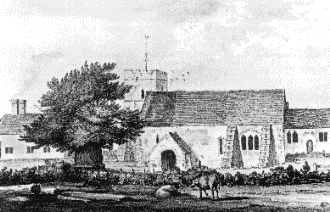 Selborne Church by Samuel Hieronymus Grimm, who did the engravings for the first edition of “The Natural History of Selborne”
- 1792: August 5, 1792 – The guns at the camp on Bagshot Heath were heard distinctly this evening.
- 1791: August 5, 1791 – Mrs H. White, & Lucy left us. Two dobchicks in Combwood pond. Young martins, & swallows cluster on the tower, & on trees, for the first time. A pleasing circumstance, mixed with some degree of regret for the decline of summer!
- 1790: August 5, 1790 – Piled & housed all the cleft wood of eight cords of beech: the proportion of blocks was large.
- 1789: August 5, 1789 – Mrs Brown brought to bed of a daughter, who makes the number of my nephews & nieces 54. Forest-fuel brought in. Beechen fuel brought in. Wood straw-berries are over.
- 1788: August 5, 1788 – Farmer Spencer’s rick slipped down as it was building.
- 1781: August 5, 1781 – Small scuds of rain. No rain to measure since July 14. On this day a bloody & obstinate engagement happened between Admiral Hyde Parker, & a Dutch fleet off the Dogger-bank.
- 1780: August 5, 1780 – My pendent pantry, made of deal & fine fly-wire, & suspended in the great wallnut tree, proves an incomparable preservative rfor meat against flesh-flies. The flesh by hanging in a brisk current of air becomes dry on the surface, & keeps ’til it is tender without tainting.
- 1776: August 5, 1776 – Mr Grim the artist left me. Began to gather apricots. Put out two rows of celeri: thr ground dry & harsh.
- 1771: August 5, 1771 – Young partridges, strong flyers. Soft showers. Swifts. Pease are hacking.
- 1770: August 5, 1770 – Hops promise well, & throw out branches at every joint.
 Theme Ported to