Posted by sydney on Jul 25th, 2008
- 1790: July 25, 1790 – Lime trees are fragrant: the golden tassels are beautiful. Dr Chandler tells us that in the south of France, an infusion of the blossoms of the lime-tree, tilia, is in much esteem as a remedy for coughs, hoarseness, fevers, &c., & that at Nismes he saw an avenue of limes that was quite ravaged & torn to pieces by people greedily gathering the bloom, which they dryed & kept for their purposes. Upon the strength of this information we made some tea of lime-blossoms, & found it a very soft, well-flavoured, pleasant, saccharine julep, in taste much resembling the juice of liquorice.
- 1789: July 25, 1789 – No garden-beans gathered yet. Threw the hay in the meadows into large cocks. The lime-trees with their golden tassels make a most beautiful show. Hops throw out their side branches, which are to bear the fruit. Cran-berries at bin pond not ripe. Hog pease are hacking at Oakhanger.
- 1786: July 25, 1786 – Pease are hacked: rye is reaping: turnips thrive & are hoing.
- 1785: July 25, 1785 – Boys bring the sixth & seventh wasp’s nest. My Nep. Edmd White sends me some fine wall-nuts for pickling. The trees at Newton were not at all touched by the severity of last winter; while mine were so damaged that all the bearing twigs were destroyed. My wall-nut trees have this summer pushed out shoots thro’ the old bark, several feet from the extremities of the boughs. While the hen-fly-catcher sits, the cock feeds her all day long: he also pays attention to the former brood, which he feeds at times.
- 1783: July 25, 1783 – Trenched two more rows of celeri in the upper end of the plot by W. Dewey’s: the ground mellow. We plant out the cabbage-kind some few at a time. The boys bring me a large wasp’s nest full of maggots.
- 1781: July 25, 1781 – The crop on my largest Apricot-tree is still prodigious, tho’ in May I pulled off 30, or 40 dozen.
- 1779: July 25, 1779 – Puff-balls come up in my grass-plot, & walks: they came from the common in the turf. There are many fairy-rings in my walks, in these the puff-balls thrive best. The fairy-rings alter & vary in their shape.
- 1778: July 25, 1778 – The water shines in the fallows. Much damage done about London by lightening on July 20.
- 1776: July 25, 1776 – Bees that have not swarmed kill their drones.
- 1774: July 25, 1774 – Grapes very small & backward for want of sun. qu: if they will ripen.
*They did in Octr.
- 1773: July 25, 1773 – Some hops much infested with aphides.
- 1772: July 25, 1772 – Wheat turns yellowish. Mercury falls very fast.
- 1768: July 25, 1768 – Cut the first cantelupe-melon.
Posted by sydney on Jul 24th, 2008
- 1792: July 24, 1792 – Preserved some cherries. My meadow-hay was carried, in decent order. As we were coming from Newton this evening, on this side of the Money-dells, a cock Fern-owl came round us, & showed himself in a very amusing manner, whistling, or piping as he flew. Whenever he settled on the turf, as was often the case, Mr Churton went, & sprung him, & brought him round again. He did not clash his wings over his back, so as to make them snap. At the top of the Bostal we found a bat hawking for moths. Fern-owls & bats are rivals in their food, commanding each great powers of wing, & contending who shall catch the phalaenae of the evening.
- 1791: July 24, 1791 – The foreign Arum in the vicarage court, called by my Grandmother Dragons, & by Linnaeus Arum Dracunculus, has lately blown. It is an Italian plant, & yet has subsisted there thro’ all the severe frosts of 80 or 90 years; & has escaped all the diggings, & alterations that have befallen the borders of that garden. It thrives best under a N. wall, but how it is propagated does not appear. The spatha, & spadix are very long.
- 1790: July 24, 1790 – Trenched four rows of celeri, good streight plants. Lime trees in full bloom. Large honey-dews on my great oak, that attract the bees, which swarm upon it. Some wheat is much lodged by the wind & rain. There is reason to fear from the coldness & wetness of the season that the crop will not be good. Windy, wet, cold solstices are never favourable to wheat, because they interrupt the bloom, & shake it off before it has perfomred it’s function.
- 1786: July 24, 1786 – Mr Richardson’s garden abounds with all sorts of crops, & with many sorts of fruits. His sandy soil produces an abundance of every thing; & does not burn in droughts like the clays, which are now bound-up so as to injure the growth of all garden matters. The watered meadows at Bramshot flourish & ook green, the uplands grass is much scorched. Mr R. has a pretty good show of Nectarines.
- 1784: July 24, 1784 – Planted bore-cole, &c. Yellow horizon. Bror Henry left us.
- 1782: July 24, 1782 – Whortle-berries ripen. Bought an aged brown Galloway of Mr Bradley of Alton.
- 1780: July 24, 1780 – Tortoise eats endive & poppies.
- 1775: July 24, 1775 – Hops throw out good side shoots & blow. Some few hills have perfect hops. A sea-lark shot at Newton-pond
- 1774: July 24, 1774 – Young swallows & martins begin to congregate on roofs. These are the first flight.
- 1773: July 24, 1773 – Wheat at Farnham £17-12-6 pr load. Several fields of cone, or bearded wheat growing this year round the village: the bloom of this wheat is of a brimstone colour. The bloom of some beardless wheat is purple: qu: what sort? The bloom of wheat in general is whitish.
- 1770: July 24, 1770 – Swallows begin to feed yir young ones flying.
Posted by sydney on Jul 23rd, 2008
- 1789: July 23, 1789 – Farmer Knight sold two loads of wheat for 36 ae! Brisk gale. Hay makes well.
- 1788: July 23, 1788 – An other wasps nest. Wheat blited at Oakhanger. Oakhanger-ponds empty: they were sewed in the spring.
- 1787: July 23, 1787 – Young red-breasts, a second brood. Notwithstanding the showery season, the aphides encrease on the hops.
- 1785: July 23, 1785 – Some water in the pond on the down. Mr. Edmd White’s tank has four feet of water.
- 1783: July 23, 1783 – Turnips (field) thrive, & are hoeing.
- 1782: July 23, 1782 – Will. Tanner shot a sparrow-hawk, which had infested the village for some time. It had lately made havock among the young swallows, & h. martins which are slow & inactive: the dams insult all hawks with impunity.
- 1781: July 23, 1781 – Of those China hollyhocks that stood the winter the tall ones are plain & single: the stunted ones are double & variegated.
- 1779: July 23, 1779 – Golden-crowned wrens, & creepers bring-out their broods.
- 1776: July 23, 1776 – Walnuts abound, but are rather small & spotted.
- 1775: July 23, 1775 – Birds are much influenced in their choice of food by colour: for tho’ white currans are a much sweeter fruit than red; yet they seldom touch the former ’til they have devoured every bunch of the latter. The male & female ants of the little yellow & little black sorts, leaving their nests, fill the air. The females seem big with eggs. They also run about on the turf, & seem in great agitation. The females wander away, & form new colonies when pregnant.
- 1773: July 23, 1773 – Turnips begin to be hoed. In general a good crop. The young clover among the corn is fine this year.
- 1772: July 23, 1772 – Martins begin to congregate on the tower.
- 1770: July 23, 1770 – Wheat is very backward: hardly any ears appear. It is worthy of notice that on my clayey soils horses prefer grass that grows on a sand-walk, tho’ shaded & dripped by a tall hedge, to that which springs from the natural ground in a sunny & open situation.
- 1768: July 23, 1768 – Martins begin to congregate on the maypole. Ricked my little mead, & finish’d my Hay-making.
Posted by sydney on Jul 22nd, 2008
- 1792: July 22, 1792 – Took the black-bird’s nest the fourth time: it contained squab young.
- 1791: July 22, 1791 – Children bring wood-strawberries in great plenty. Made straw-berry jam. Gathered currans, & rasps for jam: my rasps are fair & fine. The farmers at Selborne had not half a crop of hay. Hops thrive at this place. Merise, wild cherries, over at the vicarage, ripen.
- 1790: July 22, 1790 – A man brought me a cuckoo, found in the nest of a water-wagtail among the rocks of the hollow lane leading to Rood. This bird was almost fledge.
- 1787: July 22, 1787 – Mushrooms appear on the short Lythe.
- 1785: July 22, 1785 – Made black curran-jelly, & rasp. jam.
- 1784: July 22, 1784 – The wind broke-off a great bough from Molly White’s horse-chestnut tree.
- 1781: July 22, 1781 – All the first meadow-hay about us was spoiled: all the latter was ricked in delicate order. Late in the evening the swifts course round with their young high in the air. They are some times so numerous that one might suspect they are joined by parties from other villages. The fly-catchers have quite forsaken my house & garden: they never breed twice.
- 1778: July 22, 1778 – Sowed first endive. Planted-out Savoys, choux de Milan, cabbages, &c. The ground works well, & falls very fine. Sowed parsley, which has failed before. Planted out more annuals.
- 1776: July 22, 1776 – Bees swarm the swarm of a swarm, which swarmed itself at the beginning of June. A neighbour has had nine swarms from four stalls: two apiece from three of them, & three from one.
- 1775: July 22, 1775 – The swifts are so fledge before they quit the nest that they are not to be distinguished from their dams on the wing; yet from the encrease of their numbers, & from their unusual manner of clinging to walls & towers one may perceive that several are now out. And no wonder that they should begin to bestir themselves, since they will probably withdraw in a fortnight.
- 1774: July 22, 1774 – Hay well made at last. Swifts pursue & drive away an hawk: but do not dart down & strike him with that fury that swallows express on the same occasion. In these attacks they make some noise with their mouths, squeaking a little.
- 1773: July 22, 1773 – Wheat is now at 17s pds. per load, & very little left in the kingdom.
- 1772: July 22, 1772 – Pease begin to be hacked.
Posted by sydney on Mar 12th, 2008
- 1793: March 12, 1793 – Apricot begins to blow. red-wings, & starlings abound in the meadow, where they feed in the moist, & watered spots.
- 1792: March 12, 1792 – Carted in 6 loads of hot dung for the cucumber bed; 1 of my own, & 5 from Kimbers.
- 1791: March 12, 1791 – No frost. Planted four rows of broad beans in the orchard. Some snow still under hedges.
- 1788: March 12, 1788 – The sun mounts & looks down on the hanger. The air is milder.
- 1787: March 12, 1787 – Dogs-toothed violets begin to blow.
- 1780: March 12, 1780 – No turnips to be seen on the road.
- 1769: March 12, 1769 – Golden-crested wren, regulus cristatus, sings. His voice is as minute as his body.
Posted by sydney on Feb 29th, 2008
Posted by sydney on Feb 17th, 2008
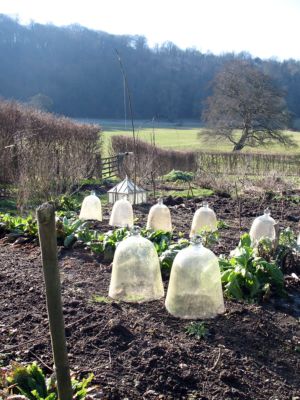
Glasses and early spinach at the reproduction of Gilbert White’s kitchen garden. Selborne, Hampshire, February 17, 2008.
- 1793: February 17, 1793 – Sent some winter-aconites in bloom to Dr. Chandler; & received back some roots of Arum dracunculus. Tubbed, & salted-up a fine young hog, bought of Timothy Turner.
- 1788: February 17, 1788 – Mr Ch: Etty sailed for Bombay, & Canton aboard the Montrose India man in the capacity of third mate. Later note: He was delayed, & did not sail till the last week in March.
- 1787: February 17, 1787 – Cucumber-plants thrive, & are pinched to make them throw-out side shoots.
- 1783: February 17, 1783 – Partridges are paired. Foot-paths in many places very clean.
- 1782: February 17, 1782 – Last night the moon was midway between Mars & Venus: she is this evening just above, close above the former, at the seeming distance of two feet.
- 1780: February 17, 1780 – Sowed a crop of spinage, the autumn-sown being much diminished by the frost. Ground works well. Planted broad-beans.
- 1779: February 17, 1779 – Bees rob each other, & fight.
- 1774: February 17, 1774 – Ravens begin to build. Spring-like weather.
- 1770: February 17, 1770 – Storm, rain, sleet.
- 1769: February 17, 1769 – Pease are sown in the fields. Land-springs abate.
Posted by sydney on Feb 16th, 2008
- 1785: February 16, 1785 – Men sow peat-ashes on their Grasses. Winter-aconites make a gay show.
- 1781: February 16, 1781 – No hares frequent the garden.
- 1779: February 16, 1779 – Crocus’s blow-out. When the vernal crocus blows, the autumnal crocus peeps out of the ground. Bees gather on the crocus.
- 1774: February 16, 1774 – Skylarks mount, & essay to sing. House-sparrows get in clusters, & chirp, & fight. Thrushes whistle.
- 1769: February 16, 1769 – Daws to the churches.
Posted by sydney on Feb 15th, 2008
- 1793: February 15, 1793 – Rain & hail in the night. Made a seedling-cucumber bed: mended the frame, & put it on.
- 1792: February 15, 1792 – Crown imperials sprout.
- 1788: February 15, 1788 – Taw & hop-scotch come in fashion among the boys.
- 1784: February 15, 1784 – Snow deep, & drifted thro’ the hedges in curious, & romantic shapes.
- 1783: February 15, 1783 – Drank tea at Newton by day-light. Sheep on the down look deplorably!
- 1781: February 15, 1781 – Strong N. aurora: very red in the N.E.
- 1779: February 15, 1779 – A vivid Aurora: a red belt from East to West.
- 1778: February 15, 1778 – The sun at tsetting shines into the E. corner of my great parlor.
- 1773: February 15, 1773 – Helleborus viridis emerges & blows.
- 1768: February 15, 1768 – Cucumber plants show two rough leaves. Forward turneps rot. Evergreens appear more damaged than at first was imagined, especially those in sunny aspects. Bees gather on ye winter aconite. Arbutus but little damaged by the frost. Ilex much hurt. Hollies, pinched by the frost, cast their leaves. Laurustinus killed to the ground.
Posted by sydney on Feb 14th, 2008
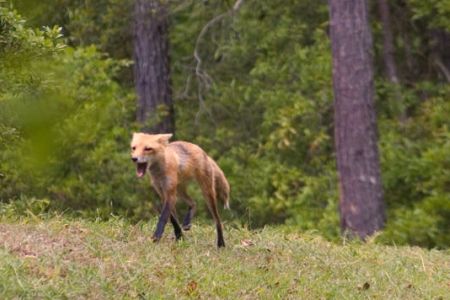
Vocalizing fox, photo by Trevor P. Hirst
- 1791: February 14, 1791 – Potted cucumbers: bed warm.
- 1786: February 14, 1786 – Bullfinches eat the buds of honey-suckles.
- 1784: February 14, 1784 – Sent Thomas as Pioneer to open the road to Faringdon: but there was little obstruction, except at the gate into Faringodn Hirn.
- 1783: February 14, 1783 – Showers. A perfect & lovely rain-bow.
- 1781: February 14, 1781 – A pair of ravens build in the hanger.
- 1778: February 14, 1778 – Foxes begin now to be very rank, & to smell so high that as one rides along of a morning it is easy to distinguish where they have been the night before. At this season the intercourse between the sexes commences; & the females intimate their wants to the males by three or four little sharp yelpings or barkings frequently repeated. This anecdote I learned by living formerly at an house opposite to a neighbour that kept a tame bitch-fox, which every spring about candlemass began her amorous serenade as soon as it grew dark, & continued it nightly thro’ ye months of Feb. & March.
- 1774: February 14, 1774 – The ivy, hedra helix, blows in Sept: Octr & Novr: the berries are now full-grown, & ripen in April: thus fructification goes on in some Instances the winter thro’. When the berries are full ripe they are black.
 Theme Ported to